

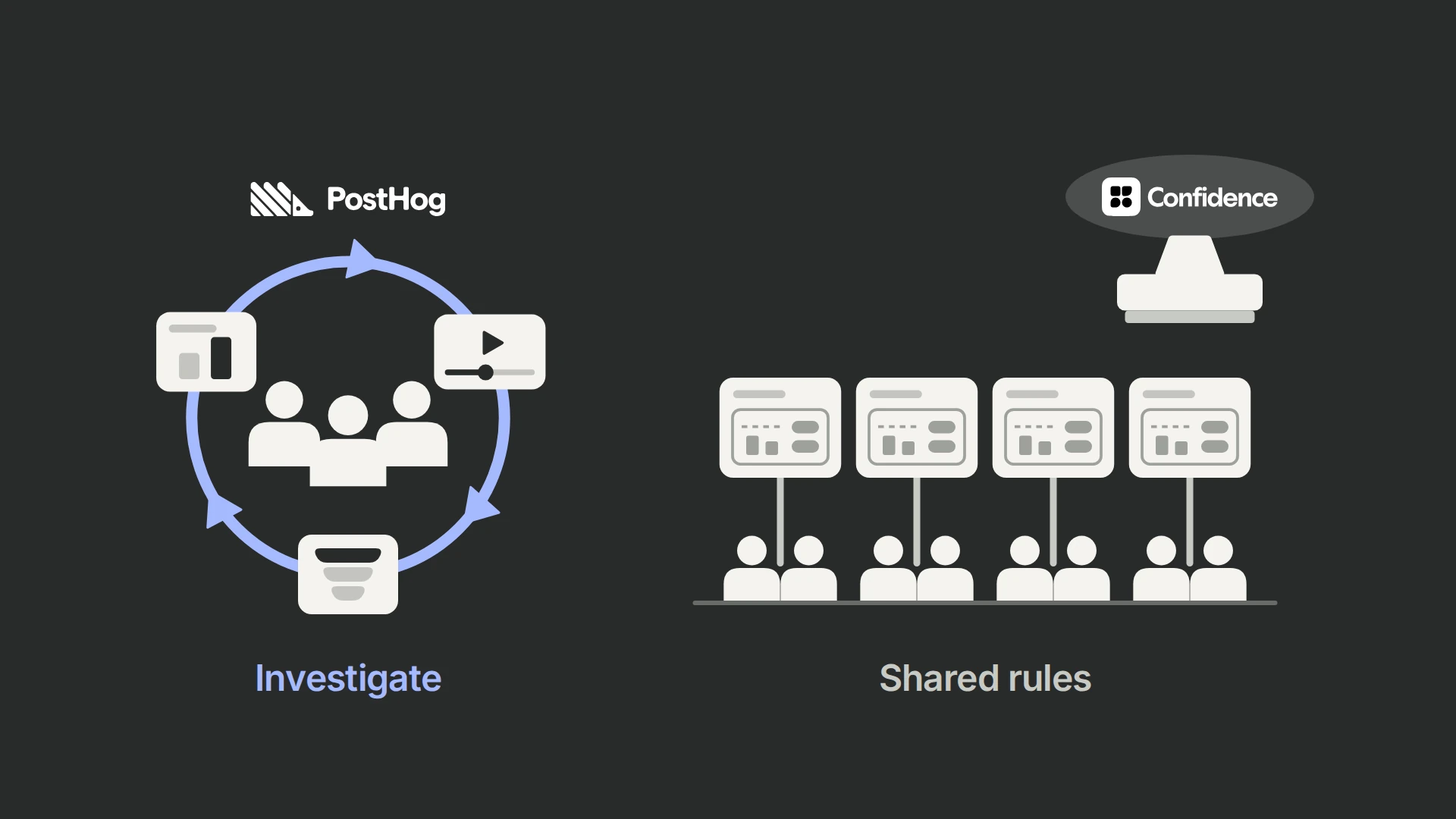
For most startups and smaller product teams, PostHog is the better choice. It combines experimentation, feature flags, product analytics, funnels, session replay, error tracking, surveys, and a data warehouse in one system, with a free tier that is difficult to beat.
Confidence by Spotify becomes the stronger choice when running experiments is itself a company-wide operating problem. Its advantage is not simply another statistical test. It gives larger experimentation programs stronger ways to define success and guardrail metrics, enforce reviews and shared metrics, coordinate overlapping tests, and analyze business outcomes in an existing warehouse.
The practical distinction is:
Choose PostHog when you want to understand users, ship a change, test it, and investigate what happened in one product. Choose Confidence when you need many teams to make experiment decisions under the same rules.
This is not a permanent verdict. Both products are changing quickly. PostHog recently closed important statistical gaps by adding CUPED and frequentist sequential testing. Confidence now advertises Analytics and Session Replay as beta products, even though its older comparison material still describes the platform as experimentation-only. Every capability and price in this article was checked on September 9, 2026.
Confidence vs PostHog at a glance
| Decision factor | Confidence by Spotify | PostHog |
|---|---|---|
| Best fit | Mature, multi-team experimentation programs | Startups and product teams wanting one integrated product stack |
| Core product | Experimentation, feature management, governed rollouts | Product analytics platform with experiments and feature flags |
| Primary data model | Warehouse-native metrics, with a separate event-ingestion option documented for Total Confidence | PostHog events, funnels, and synced warehouse tables |
| Product analytics | Analytics is advertised as beta | Mature native product and web analytics |
| Session replay | Advertised as beta | Mature native session replay tied to experiment variants |
| Statistical approaches | Frequentist | Bayesian or frequentist |
| Sequential testing | Group sequential and always-valid | Always-valid frequentist confidence sequences; Bayesian results also support continuous reading under their model |
| CUPED | Yes | Yes |
| Sample ratio mismatch checks | Yes | Yes |
| Multiple-comparison handling | Built into its success-metric decision framework | No correction by default for multiple variants or metrics |
| Guardrails | Formal guardrail roles, optional non-inferiority margins, required metrics | Primary and secondary metrics; decision discipline remains largely with the team |
| Program governance | Surfaces, required reviews, required metrics, holdbacks, exclusivity groups | Shared metrics and holdouts; less policy enforcement across teams |
| Experiment without vendor flags | Can analyze configured assignment tables, including assignments from another flag system | Supports experiments without PostHog feature flags |
| Flag evaluation | Central, edge, or locally deployed resolver; OpenFeature-based | Client and server SDKs, including local evaluation in supported server SDKs |
| Open source / self-hosting | Managed, proprietary product | Much of PostHog is MIT-licensed; cloud and self-hosting options |
| Free entry point | 75,000 monthly credits | 1M analytics events and 1M feature-flag requests monthly, plus separate free allowances for other products |
| Paid pricing shape | From $449 per month for 750,000 credits | Metered usage by product; experiments are billed through feature-flag usage |
The table is useful for orientation, but the architectural and governance differences matter more than the feature count.
The architecture difference that should drive the decision
PostHog is event-centric. A feature flag assigns a participant to a variant, an exposure event records that assignment, and PostHog computes the experiment metrics from events it can query. Funnel, mean, ratio, and retention metrics are native. PostHog can also use synced data-warehouse tables, and it can map external warehouse properties into targeting rules.
The typical flow is:
participant → PostHog flag → exposure → PostHog events → experiment result
with an optional path from synced warehouse data into the metric layer.
That design reduces the distance between a result and an investigation. If a checkout treatment loses, a team can move from the experiment to the relevant funnel, event properties, errors, and recordings without first reconciling several products. PostHog’s experiment metric documentation also makes the unit of analysis explicit: a revenue sum is first calculated per user and then averaged across users, rather than comparing raw arm totals.
Confidence brings experiment analysis to the warehouse
Confidence is designed around assignments and business facts that often already live in a warehouse. In its warehouse-native setup, assignment data is written to Snowflake, BigQuery, Databricks, or Redshift. Confidence queries fact tables, calculates one value per experimental entity, joins those values to exposure, and computes results by variant. Intermediate exposure and metric data is also written to the customer’s warehouse. Its Snowflake setup guide shows the permissions and schemas this requires.
The typical flow is:
participant → Confidence flag → assignment in warehouse
then:
assignment + warehouse facts → per-entity metric → statistical decision
This matters when the decisive outcome is not a browser event. Gross margin after refunds, retained subscription revenue, claims, fulfillment cost, support contacts, and 30-day cancellations may already have trusted definitions in finance or operational models. Confidence can analyze those definitions without requiring the company to rebuild them as a second event taxonomy.
There is an important nuance that simple comparisons miss: Confidence’s current metric documentation describes both a warehouse-native configuration and a Total Confidence option based on events sent through Confidence SDKs. It is therefore too broad to say that every Confidence deployment requires pre-existing business events in a warehouse. The warehouse remains the product’s architectural center and its clearest differentiator.
The operational cost of each architecture
PostHog’s integrated model is easier to adopt when the team does not already have a mature warehouse. The same instrumentation can power product analytics and experiments. The tradeoff is tighter coupling between experimentation and PostHog’s event and identity model. Warehouse tables can extend that model, but PostHog is still the analysis environment.
Confidence lets an established warehouse remain the source of metric truth. The tradeoff is real setup and ownership: assignment connectors, read/write permissions, fact tables, entity keys, partitioning, compute cost, and data freshness must all work. Confidence’s Snowflake setup, for example, requires schemas for assignment and exposure data, warehouse compute permission, and read access to the business fact tables used by metrics.
If your team does not know who owns those pieces, “warehouse-native” is a liability rather than an advantage.
Feature flags and exposure quality
Both platforms can assign stable variants and avoid a blocking network request on every server-side evaluation.
Confidence supports central and edge resolvers as well as a locally deployed sidecar resolver. Its SDK strategy uses OpenFeature, which reduces the amount of vendor-specific evaluation code and makes a future provider change more practical. Sticky assignment is available on the Growth plan for cases where a participant must retain a treatment after eligibility data or rules change.
PostHog’s server SDKs can evaluate flags locally after fetching definitions. Its browser SDK caches values, and server-evaluated flags can be bootstrapped into the browser to prevent visible treatment flicker. PostHog experiments normally use a $feature_flag_called event as exposure, but a custom event can narrow exposure to people who reached the relevant product surface. It can also exclude participants observed in multiple variants, as described in its experiment creation workflow.
The more important comparison is exposure correctness, not nominal flag speed. During a proof of concept, test all of the following:
- Anonymous-to-identified identity transitions.
- Assignment consistency across web, mobile, and backend services.
- Retry and offline behavior.
- Whether evaluation and actual treatment exposure are the same event.
- Bot, employee, and test-account exclusions.
- Multiple-variant contamination.
- Assignment-to-revenue joins for late outcomes.
A fast flag with a misleading exposure event produces a fast, misleading experiment.
Statistics: the gap is smaller, but the decision models still differ
Older comparisons say PostHog lacks CUPED or frequentist sequential testing. That is no longer accurate. PostHog now documents both CUPED variance reduction and an always-valid frequentist sequential mode based on confidence sequences. Confidence also supports CUPED, and it offers both group sequential tests and always-valid inference.
Bayesian and frequentist options
PostHog lets a team choose Bayesian or frequentist statistics per experiment. The Bayesian view reports probabilities and credible intervals. Its frequentist implementation includes confidence intervals, Welch-style tests, outlier handling, CUPED, and optional always-valid sequential inference.
Confidence is frequentist and more opinionated. Success metrics use superiority tests. Guardrail metrics can use inferiority tests or non-inferiority tests with a tolerance chosen before the result is known. Teams that require a Bayesian decision model should prefer PostHog or plan a separate analysis workflow.
More choice is not automatically better. A team that switches statistical language from one test to the next without a decision policy can become less consistent. Confidence’s narrower method set is valuable when standardization is the goal; PostHog’s flexibility is valuable when an experienced analyst can govern the choice.
Sequential testing
Both products now support valid repeated reading of frequentist results, but Confidence offers a broader choice.
PostHog’s sequential mode produces always-valid p-values and confidence sequences. It is appropriate when a team wants to monitor continuously without inflating the false-positive rate from uncontrolled peeking. The cost is wider intervals than a fixed-horizon test.
Confidence uses a group sequential test when an expected sample size is provided and always-valid inference when it is not. Its sequential testing documentation recommends the group sequential option when sample size is reasonably predictable because it normally retains more power. Confidence also runs sequential deterioration checks even when the primary result is configured for end-of-test analysis.
If your experiments are low-volume, this efficiency difference can matter. If your team rarely has enough traffic to detect the minimum effect it cares about, neither platform can manufacture statistical power.
Multiple variants and multiple metrics
This is still a material difference.
PostHog compares each treatment with control independently and applies no multiple-comparison correction by default. It also tests metrics independently. Its documentation illustrates the practical risk: under a global null with ten independent metrics tested at a 5% threshold, the chance of at least one false positive is about 40%.
PostHog recommends defining primary metrics before launch, but the platform still relies on analyst discipline to interpret a page full of results.
Confidence treats the set of decision metrics as a joint design problem. It applies a Bonferroni correction across success metrics and adjusts per-guardrail power so all protected outcomes can pass together. Adding success metrics or guardrails therefore changes the required sample. Confidence documents the exact composite rule and adjustments in its multiple-comparison methodology. This makes an experiment harder to declare successful for a good reason: the decision promised more than one thing.
Guardrails are Confidence’s clearest advantage
Suppose a checkout treatment raises purchase conversion but might increase refunds or support contacts.
In PostHog, the team can add those as secondary metrics and inspect the result. Primary and secondary are organizational labels; the metric calculations work the same way. The team must decide what amount of harm is acceptable and whether the experiment collected enough evidence to rule that harm out.
Confidence gives those metrics distinct statistical roles. A success metric asks whether the treatment improved the intended outcome. A guardrail can ask whether deterioration is present, or it can use a non-inferiority margin to ask whether any harm is smaller than a prespecified tolerance. Its metric design connects those roles to power analysis and the final decision.
That supports a more useful preregistration statement:
Ship if purchase conversion improves, provided refunds do not rise by more than 0.5 percentage points and support contacts do not rise by more than 0.2 percentage points.
The numbers are business judgments, not statistical defaults. Confidence cannot decide what damage your company should accept. It can force the company to state that judgment before seeing flattering results and test the claim coherently.
For mature experimentation programs, this is more valuable than adding another chart.
Governance: Confidence manages a program, PostHog manages experiments
Confidence organizes experiments around Surfaces, such as checkout, search ranking, or the mobile home screen. A surface can add required reviewers, shared required metrics, holdbacks, notifications, and exclusivity rules. Required reviews can block launch. Required metrics appear automatically, making it harder for one team to omit a company-wide health metric. Confidence documents these controls as surface settings.
Confidence can also coordinate mutually exclusive experiments. Two teams changing the same ranking system can share an exclusivity group so a participant is not exposed to both tests. Reusable holdbacks support longer-term comparisons across a collection of changes.
PostHog has reusable shared metrics and experiment holdouts. These are useful building blocks, but its current experiment workflow does not offer a direct equivalent to Confidence’s surface-level combination of enforced reviewers, required metrics, and exclusivity groups. A disciplined team can implement policies outside PostHog; Confidence turns more of that policy into the product.
This is the point at which company size alone becomes a poor buying rule. A 500-person company with one centralized experimentation team may be comfortable in PostHog. A 100-person company with ten autonomous squads changing the same product may already benefit from Confidence.
The better question is: what happens when an experiment is badly designed?
- Does a reviewer have to approve it?
- Can a team omit the reliability metric owned by another team?
- Can interacting experiments expose the same customer?
- Is the stopping rule set before results appear?
- Does the result page make an overall decision reproducible?
If the answers depend on remembering a document, governance may be the real bottleneck.
Investigation after an experiment
PostHog remains stronger for established, integrated behavioral investigation.
An analyst can move from a surprising experiment result into product events, funnels, paths, errors, cohorts, and session recordings in the same environment. Data uses the same person and group identities. For teams whose next question is usually “what did users do differently?”, that continuity saves time and reduces reconciliation mistakes.
Confidence historically depended on the surrounding analytics stack for this work. Its current site advertises Analytics and Session Replay as beta, along with an AI agent. Those features narrow the headline scope gap, but beta availability is not equivalent to PostHog’s mature analytics and replay products. A serious evaluation should verify access, retention, privacy controls, SDK coverage, and how reliably replay sessions join to experiment assignments.
Do not buy either product because an AI summary claims to explain why a metric moved. Replays and segment patterns generate hypotheses. The randomized outcome estimates the treatment effect; qualitative observations do not prove the mechanism.
Can Confidence and PostHog work together?
Yes, and coexistence is often safer than a big-bang migration.
A team can keep PostHog for product analytics and replay while using Confidence for assignment, warehouse metrics, and experiment decisions. Confidence exports flag assignments through connectors, and its warehouse setup can use assignment data that already exists rather than requiring Confidence Flags. Conversely, PostHog supports experiments without its own feature flags and can use warehouse tables as experiment metrics.
That flexibility does not mean both products should assign the same experiment independently. Two randomization systems can put the same person in different variants. Pick one assignment authority per experiment, persist its experiment key, variant, entity ID, and timestamp, then reconcile both tools to that record.
A staged migration can follow this sequence:
- Keep the existing flag system and reproduce one completed experiment in the candidate analysis system.
- Reconcile exposure and metrics before changing live assignment.
- Run one low-risk experiment with a single assignment authority and dual downstream observation.
- Compare late warehouse outcomes after the full conversion window.
- Migrate SDK evaluation only if governance, latency, and failure behavior justify it.
This separates three decisions that vendors tend to bundle together: where flags resolve, where behavioral data lives, and where the experiment decision is computed.
Pricing: compare your units, not the headline plans
The products charge for different things, so a single “cheaper” label is misleading.
Confidence counts credits. One credit represents one unique user exposed to experimentation in a month, according to its current pricing page. The Free plan includes 75,000 monthly credits, unlimited flags and seats, and up to five surfaces. Growth starts at $449 per month for 750,000 credits and up to 15 surfaces. The pricing page lists Growth tiers up to 2.5 million credits for $999 per month, separate top-up packs, and custom Enterprise pricing. Confidence says it does not charge overages automatically.
PostHog meters each product separately. Its current pricing page includes monthly free allowances of 1 million analytics events, 1 million feature-flag requests, 5,000 recordings, and 1 million warehouse rows. Experiments are billed through feature-flag usage. Beyond the free allowance, analytics currently starts at $0.000198 per identified event and $0.00005 per anonymous event, with volume pricing and distinct rates for flags, replay, warehouse use, and other products.
The real cost depends on your usage model
For a small team that needs analytics and replay anyway, PostHog can replace several purchases and may cost nothing initially. Confidence’s paid entry is higher, but its unique-exposed-user unit may be more predictable than counting every event and service separately.
At scale, model at least three scenarios rather than multiplying a list price:
| Cost input | Confidence | PostHog |
|---|---|---|
| Experiment population | Monthly unique exposed entities | Feature-flag requests; validate how each SDK/evaluation mode is metered |
| Behavioral analytics | Existing analytics cost or beta product terms | Analytics event volume |
| Replay | Existing replay cost or beta product terms | Recorded sessions and retention choices |
| Warehouse | Your query, storage, assignment, and exposure-table costs | Synced warehouse rows and any source-system costs |
| Governance/access | Surface limits and plan features | Platform packages for access controls and related features |
| People/operations | Warehouse and experimentation-program ownership | Instrumentation and multi-product administration |
Use one real month of traffic and the exact evaluation design. Do not infer billable PostHog request volume from pageviews alone; verify it in the pricing calculator and usage dashboard for the SDK pattern you will deploy. Confidence warehouse queries and cached intermediate tables can materially change warehouse compute and storage. Enterprise discounts make linear extrapolation unreliable for both vendors.
Which teams should choose PostHog?
Choose PostHog when most of these statements are true:
- You need product analytics, replay, feature flags, and experimentation together.
- Your product and experiment events already live in PostHog.
- You have one to a handful of teams running a modest number of experiments.
- Analysts need to investigate behavior immediately after reading a result.
- Low setup cost and a generous free tier matter.
- Bayesian analysis is preferred, or you want the option to choose Bayesian or frequentist methods.
- Your team can define primary metrics, guardrails, stopping rules, and overlapping-test policy through its own review process.
- Open-source availability or self-hosting is an important constraint.
PostHog is especially compelling when the alternative is buying analytics, replay, flags, and experimentation separately before the experimentation program has proved its value.
Which teams should choose Confidence?
Choose Confidence when most of these statements are true:
- Several teams run experiments concurrently on shared product surfaces.
- Trusted business outcomes already live in Snowflake, BigQuery, Databricks, or Redshift.
- You need success and guardrail metrics to participate in one formal decision rule.
- Non-inferiority margins matter for reliability, risk, revenue quality, or customer harm.
- Required reviewers and organization-wide metrics should be enforced by the platform.
- Experiment interference, exclusivity, sticky assignments, and reusable holdbacks are recurring concerns.
- You prefer opinionated frequentist methodology, including group sequential testing.
- OpenFeature portability fits your feature-management architecture.
- You already have analytics and replay, or you have verified that Confidence’s beta products meet your requirements.
Confidence is a poor fit when the team has no warehouse owner, little experiment traffic, a strong Bayesian requirement, or a simple need for occasional landing-page tests.
Pros and cons
PostHog strengths
- Broad, mature analytics suite around the experiment.
- Fast path from outcome to behavioral diagnosis.
- Generous product-by-product free allowances.
- Bayesian and frequentist choices.
- CUPED, sequential testing, outlier handling, ratio metrics, retention metrics, and warehouse-derived metrics.
- Open-source code and self-hosting options.
- One identity and event model across analytics, replay, flags, and experiments.
PostHog limitations
- No multiple-comparison correction by default.
- Primary and secondary metric labels do not create a formal multi-metric ship rule.
- Company-wide review, required-metric, and exclusivity policies need more external process.
- Costs can span several usage meters and depend on instrumentation choices.
- Coupling analytics, flags, and experiment analysis increases the work required to change platforms later.
Confidence strengths
- Strong success/guardrail semantics and non-inferiority tests.
- Multiple-metric error control and power planning tied to the decision.
- Group sequential and always-valid frequentist methods.
- Surface-level reviews, required metrics, holdbacks, and experiment coordination.
- Deep use of existing warehouse business models.
- OpenFeature-centered flag integration and multiple resolver options.
- Pricing based on unique monthly experiment exposure rather than every behavioral event.
Confidence limitations
- Higher paid entry point.
- More concepts and operational ownership than a small program may need.
- Warehouse compute, permissions, freshness, and schema quality become part of experiment reliability.
- Frequentist-only analysis may conflict with an established Bayesian decision process.
- Analytics and replay are currently advertised as beta, so breadth should be validated rather than assumed.
- Managed proprietary platform without PostHog’s self-hosting path.
How to evaluate both products in two weeks
Do not evaluate with a button-color demo. Use one completed experiment whose decision was genuinely difficult.
Choose a test with:
- one binary conversion metric;
- one skewed revenue or usage metric;
- one guardrail with a meaningful tolerance;
- an anonymous-to-identified journey;
- a late warehouse outcome such as refund, renewal, or cancellation;
- enough historical data to test variance reduction;
- one segment worth investigating but not promoting as a causal winner.
Then score both systems on the same tasks:
| Evaluation task | What to verify |
|---|---|
| Assignment | Stable treatment across clients, services, login, retries, and rule updates |
| Exposure | The analysis includes people who could actually experience the change |
| Metric parity | Counts reconcile with the trusted source and include zero-outcome participants |
| Late outcomes | Refunds or renewals join to original assignments over an equal observation window |
| Statistics | MDE, power, CUPED, sequential settings, outliers, and metric roles are explicit |
| Guardrail decision | The platform can represent the actual acceptable-harm threshold |
| Interference | Concurrent tests can be detected, coordinated, or intentionally allowed |
| Investigation | Analysts can move from aggregate result to useful diagnostic evidence |
| Governance | Reviewers, definitions, edits, launch state, and decisions leave an auditable record |
| Cost | A real traffic month maps to documented billing units and warehouse costs |
| Failure behavior | Flag and event pipelines degrade safely during network or warehouse failures |
| Exit path | Assignment history, metrics, and SDK calls can be exported or replaced |
Do a blind reconciliation before comparing the user interfaces. If the two systems disagree, trace assignment, eligibility, exposure, identity, time windows, zeros, and late-arriving data. That investigation usually teaches more than the sales demo.
For the wider measurement checks around this proof of concept, use the 99Ways experimentation system audit and PostHog audit. Our A/B testing metrics guide explains why the primary outcome should sit close to the business decision.
Final recommendation
Pick PostHog by default if you are building the experimentation practice and still need the surrounding analytics stack. It offers serious experimentation capabilities, and its integrated behavioral context is more useful to most growing teams than governance they will not yet exercise.
Pick Confidence when the limiting factor is consistent decision-making across an experimentation program. Its strongest advantages appear when many teams share product surfaces, business metrics live in a mature warehouse, regressions need formal tolerance limits, and experiment policy must survive beyond one careful analyst.
Do not migrate from PostHog solely for CUPED or peeking-safe frequentist results; PostHog now has both. Do not reject Confidence solely because it historically lacked analytics and replay; those products are now advertised in beta, though they still require a serious capability check.
For 99Ways’ current way of working, we would stay with PostHog. Direct movement between experiment results, funnels, events, and replay fits our investigative workflow, while our experiment volume does not yet justify a separate governance platform. We would revisit Confidence when overlapping tests, required cross-team guardrails, or reproducibility across many experiment owners becomes the bottleneck.
Frequently asked questions
Is Confidence better than PostHog for A/B testing?
Confidence is better for a mature, governed experimentation program. PostHog is better for most smaller teams that want experimentation inside a broader analytics and replay platform. The right answer depends more on program coordination and data architecture than on basic A/B test support.
Does PostHog support CUPED and sequential testing?
Yes. Current PostHog documentation describes CUPED variance reduction and optional frequentist sequential testing with always-valid p-values and confidence sequences. Comparisons claiming PostHog has neither are outdated.
Does Confidence require a data warehouse?
Confidence is built around warehouse-native analysis and supports Snowflake, BigQuery, Databricks, and Redshift. Its documentation also describes a Total Confidence setup using events sent by its SDKs. Validate the exact product and data-flow option available to your account; the warehouse architecture remains the clearest reason to choose Confidence.
Can Confidence replace PostHog analytics and session replay?
Confidence now advertises Analytics and Session Replay as beta. That is not enough evidence to assume feature parity with PostHog’s mature products. Test access, query depth, replay capture, privacy controls, retention, and experiment joins before treating them as replacements.
Which platform is cheaper?
PostHog is usually cheaper for an early-stage team, especially when its free analytics, flag, and replay allowances replace other tools. Confidence’s Free plan covers 75,000 monthly credits, while Growth starts at $449 per month for 750,000 credits. At larger scale, compare unique exposed users, flag-evaluation design, event volume, replay, warehouse compute, governance packages, and existing analytics costs.
Can PostHog use warehouse data for experiments?
Yes. PostHog supports experiment metrics based on data-warehouse tables and can map warehouse properties for targeting. The difference is emphasis: synced warehouse data extends PostHog’s integrated analytics model, while Confidence centers experiment computation and assignment data around the customer’s warehouse.
What is the biggest statistical difference?
Confidence provides a more formal multi-metric decision system. It distinguishes success and guardrail roles, supports non-inferiority margins, adjusts the design for multiple success metrics, and powers guardrails together. PostHog offers strong individual metric analysis but applies no multiple-comparison correction by default.
When should a PostHog team reconsider Confidence?
Reconsider when many teams run concurrent tests, outcomes depend on mature warehouse models, experiments interfere, shared guardrails need enforcement, or decision quality varies too much by analyst. At that point the problem has shifted from running an A/B test to governing an experimentation program.