
A conversion tracking audit determines whether the events in your analytics system describe the business actions you think they describe.
Funnel data is trustworthy only when a representative user journey produces the correct events, at the correct moment, with the correct properties, identity, and acquisition context; when duplicates and missing events are understood; and when the resulting totals reconcile with operational systems closely enough for the intended decision.
That is a higher standard than confirming that a tag fires.
A browser request can reach GA4, PostHog, Meta, or Google Ads while the measurement is still wrong. The event may fire before the action succeeds, fire twice after a refresh, lose the original traffic source during checkout, attach to a new anonymous profile after login, omit revenue or currency, or count an order that was later cancelled.
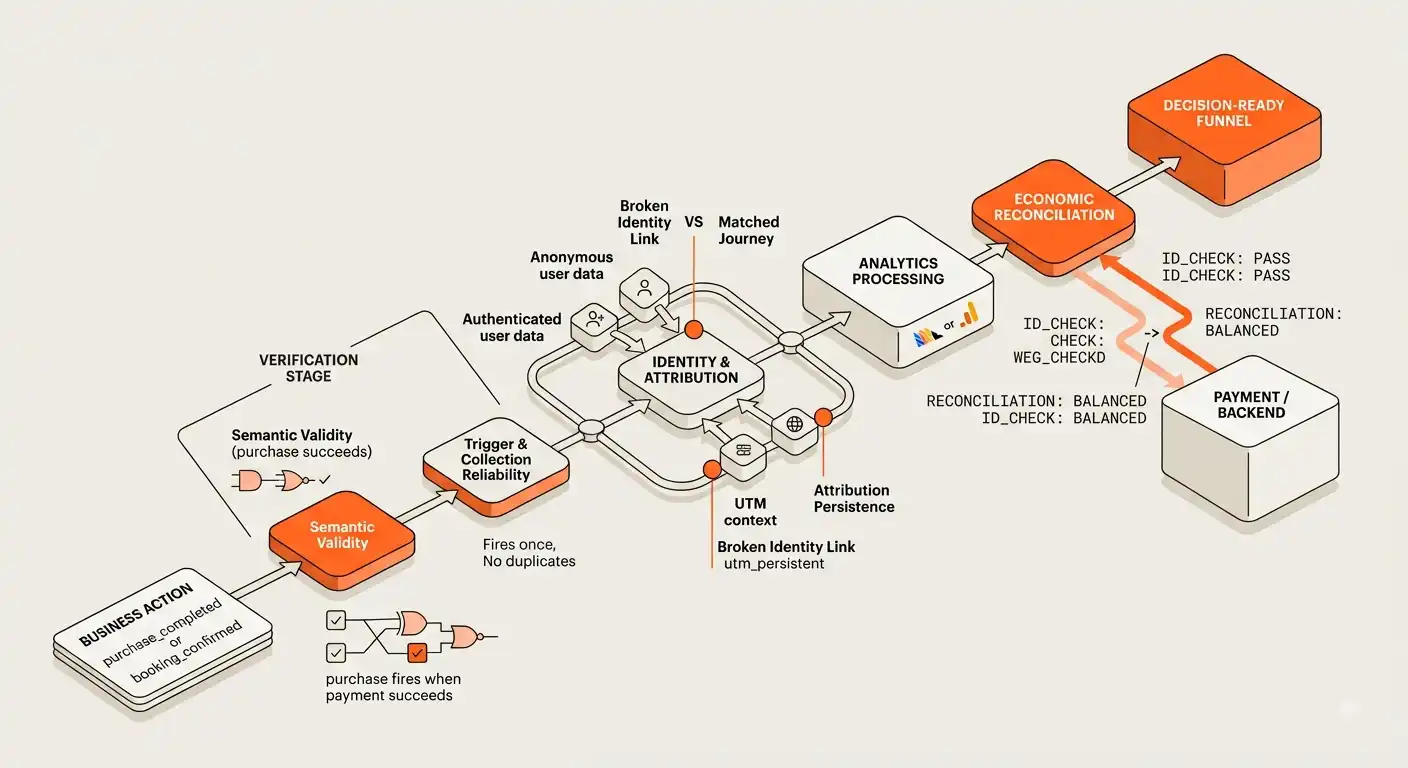
A serious audit follows the entire measurement chain:
Business action -> trigger -> event payload -> identity -> session and source -> analytics processing -> operational record -> report or optimization system
The question is not merely, “Did data arrive?” It is, “Can this data support the decision we are about to make?”
A firing tag proves transport, not truth
Tag Assistant, DebugView, browser network logs, and analytics activity feeds are useful. They show whether a request was generated and what payload was sent. Google recommends these tools for immediate implementation verification. (Google Analytics verification guide)
But successful transport does not prove that the event is valid.
Suppose a purchase event appears in the browser network panel. Before trusting it, an audit still needs to answer:
- Did payment actually succeed?
- Does the event fire once per order or once per confirmation-page load?
- Does it contain the correct order ID, revenue, and currency?
- Is tax, shipping, discount, or refund treatment defined consistently?
- Is the event attached to the same person who entered the funnel?
- Did the original campaign survive redirects and domain changes?
- Does the browser event duplicate a server or ecommerce-platform event?
- Does the order appear in the billing or ecommerce system?
- Does the advertising platform receive the same business event or a different approximation?
If those questions are unanswered, the event exists, but the decision quality is unknown.
What trustworthy conversion data must prove
A trustworthy event passes five tests.
| Trust dimension | The event must prove | Typical failure |
|---|---|---|
| Semantic validity | It represents the intended business action | purchase fires when checkout opens rather than when payment succeeds |
| Collection reliability | It fires for the eligible paths, once per logical action | Refreshes create duplicates or one payment method is never tracked |
| Identity continuity | It remains attached to the correct user or account | Anonymous and authenticated activity split into separate profiles |
| Attribution continuity | Relevant source and campaign context survive the journey | A checkout domain or redirect turns paid traffic into direct or referral traffic |
| Economic reconciliation | Counts and values can be explained against operational records | Analytics reports more orders or revenue than the payment system |
Finally, a sixth condition is operational durability: in other words, the measurement must continue to remain valid even after releases, tag changes, consent interactions, checkout changes, and the introduction of new traffic sources.
The conversion tracking audit framework
A useful audit starts with the decision and works backward through the data required to support it.
The sequence is:
- Define the business action and system of record.
- Map the full customer and data journey.
- Verify event meaning, triggers, properties, and uniqueness.
- Verify identity, session, and cross-domain continuity.
- Verify acquisition, consent, and browser/server behavior.
- Reconcile analytics with operational systems.
- Test production paths and establish monitoring.
- Rank remediation by the decisions at risk.
1. Define the business action before inspecting the implementation
The same event name can represent materially different facts.
For example, “purchase” could mean:
- an order object was created;
- a card authorization succeeded;
- payment was captured;
- a subscription started;
- a trial converted;
- an invoice was paid;
- a renewal was collected; or
- a customer reached a confirmation page.
Those events are related, but they are not interchangeable.
The audit should write an operational definition before reviewing the tags:
purchase_completedfires once when the payment system confirms a successfully captured customer order. The event uses the payment or order ID as its unique identifier and includes net item value, currency, product IDs, customer status, and the original acquisition identifiers available for that user.
The definition should specify:
- the business condition that must be true;
- the exact trigger source;
- the eligible population;
- whether retries, renewals, refunds, or cancellations create separate events;
- the unique business identifier;
- required properties;
- the system of record;
- expected delay; and
- downstream uses such as reporting, ad optimization, or experimentation.
This is where many audits discover that the team does not have a tracking problem yet. It has a definition problem.
Choose the system of record by question
There is rarely one universal source of truth.
- The payment processor may be authoritative for captured payments.
- The ecommerce platform may be authoritative for order contents and fulfillment state.
- The CRM may be authoritative for lead qualification and closed sales.
- The product database may be authoritative for account activation or feature use.
- The analytics system may be authoritative for the behavioral sequence observed before those outcomes.
A good audit defines which system is authoritative for each fact and how the systems should connect.
2. Map the complete journey and measurement path
Tracking often breaks at boundaries rather than on the main landing page.
A journey may cross:
- a marketing domain;
- a separate store or checkout domain;
- an embedded form;
- a scheduling tool;
- an app or member portal;
- a payment processor;
- a CRM;
- a mobile app;
- server-side webhooks; and
- several advertising destinations.
The audit should draw two maps.
The customer journey map
This map shows what the person does:
Ad click -> landing page -> product or application -> checkout or booking -> payment -> fulfilment or sales outcome
The data journey map
This map shows what the systems do:
Browser or app -> tag or SDK -> analytics platform -> backend or payment event -> CRM or warehouse -> ad platform -> dashboard
Every transition creates a possible failure point.
For instance, Google’s cross-domain documentation provides a concrete example: when cross-domain measurement is not configured, a person who moves from an online store to a separately hosted cart may consequently be counted as two users across two separate sessions. (Google cross-domain measurement)
The audit should therefore identify:
- every domain, subdomain, app, iframe, and redirect;
- where identifiers are created, changed, or cleared;
- where UTMs and click IDs enter and may disappear;
- which system emits each critical event;
- where browser and server events overlap;
- where consent changes what is collected; and
- where a business outcome is joined back to the original visitor.
A homepage scan cannot validate this architecture. The audit must follow complete journeys.
3. Verify event semantics, triggers, properties, and uniqueness
An event can be technically present and analytically unusable.
In 99ways audit work, we have encountered events that fired without the corresponding user-visible state and progression events that lacked the program, day, or step properties required to distinguish one journey from another. Both implementations produced data. Neither could reliably answer the intended question until the trigger and context were repaired.
For every critical event, test four things.
Trigger correctness
Confirm the event fires when the business action occurs, not merely when a related interface appears.
Examples:
- A form submission event should require successful acceptance, not a button click.
- A purchase event should require the defined payment state, not a thank-you page render.
- A booking event should distinguish a slot selection from a confirmed booking.
- A trial conversion should reflect the agreed billing condition, not an app-open event after the trial period.
Coverage
Test every meaningful path, not one happy path.
Coverage may vary by:
- device and browser;
- logged-in versus anonymous users;
- payment method;
- product or plan;
- geography;
- consent state;
- app version;
- traffic source;
- new versus returning customer; and
- successful, failed, cancelled, refunded, or repeated action.
Event properties
Furthermore, a correct event name alone is not enough; without useful properties, the range of questions the business can answer remains limited.
Therefore, critical conversion properties often include:
- transaction, order, booking, lead, or account ID;
- value and currency;
- product, plan, or service;
- quantity and discount;
- customer or subscription status;
- funnel step or surface;
- source, medium, campaign, and click IDs;
- experiment or feature-flag context;
- app or site version; and
- event timestamp and relevant conversion window.
In particular, Google’s tag documentation recommends using a unique transaction_id to support conversion deduplication, while also including value and currency parameters to ensure more meaningful revenue reporting. (Google tag event guidance)
Uniqueness and ordering
The audit must determine whether the same logical business action is recorded once.
Common duplicate causes include:
- confirmation-page refreshes;
- browser and server events without a shared event ID;
- multiple tag-manager containers;
- retry logic without idempotency;
- both a platform integration and custom code sending the same event; and
- one event being generated at several funnel stages under the same name.
Also test sequence. A purchase should not appear before checkout for the same journey unless the architecture explains why. Late server events should retain the correct original event time rather than being interpreted as a new session conversion.
4. Verify identity, session, and cross-domain continuity
A funnel can look healthy at the aggregate level while individual journeys are fragmented.
Identity testing should cover:
- anonymous visitor to signup or login;
- logout and reset behavior;
- email, account ID, device ID, and anonymous ID rules;
- aliasing or identity merges;
- multiple devices and browsers;
- shared devices;
- cross-domain navigation;
- app-to-web or web-to-app transitions; and
- Additionally, payment or CRM events may arrive only after the browser session has already ended.
The audit should answer:
- Which identifier is used before authentication?
- Which identifier becomes authoritative after authentication?
- How are the two connected?
- Can the same person be represented by multiple permanent profiles?
- Can two people be incorrectly merged?
- Does the original source remain attached after identity resolution?
- Which cross-device behavior is measurable, and which is inherently unobserved?
Nevertheless, a clean-looking funnel does not necessarily prove identity continuity. Therefore, test users should be traced event by event, from the initial touchpoint through to the final business outcome.
5. Verify attribution, consent, and browser/server behavior
Attribution quality depends on collection details that are easy to hide behind a polished report.
Preserve acquisition context through the journey
Test the actual final campaign URL in a clean session. Confirm that:
- UTMs and click IDs arrive on the first page;
- redirects preserve them;
- the first landing URL is stored where needed;
- internal links do not overwrite acquisition attribution;
- the checkout or app receives the identifiers required for continuity;
- the final conversion can be joined back to the original source; and
- payment processors or internal domains do not appear as new acquisition sources.
99ways’ practical UTM guide covers the naming and end-to-end verification process in more detail: How to Build Consistent UTMs for Reliable Marketing Attribution.
Test consent states rather than assuming them
Consent can change which tags load, which events are sent, and which identifiers are available.
The audit should test at least the relevant accept, reject, and partial-consent paths in the markets where the business operates. Google’s consent debugging guidance explicitly recommends checking the default state, the update after user interaction, and which tags fired or were blocked under each state. (Google consent-mode troubleshooting)
This is an implementation audit, not a legal determination. The audit can verify that the configured policy is executed consistently; legal counsel or the responsible privacy team must define the policy.
Treat server-side tracking as another measured system
Furthermore, server-side collection can capture backend and offline outcomes while also reducing dependence on a browser page load. However, this does not automatically mean that the underlying event definitions are correct.
Google describes Measurement Protocol as a way to supplement, not replace, browser or app collection. (Google Analytics Measurement Protocol)
A server-side audit should verify:
- event generation logic;
- event and transaction IDs;
- browser/server deduplication;
- identity and session linkage;
- timestamps and conversion windows;
- values and currencies;
- consent propagation;
- retries and idempotency;
- payload validation; and
- destination-specific transformations.
A server event can be more durable than a thank-you-page event and still be semantically wrong, duplicated, late, or attached to the wrong user.
6. Reconcile analytics with operational systems
Trust does not require every platform to show the same number.
Different systems can legitimately disagree because they use different:
- event definitions;
- attribution models;
- time zones;
- reporting delays;
- conversion windows;
- consent and identity coverage;
- refund and cancellation treatment;
- currency conversion;
- bot and internal-traffic filters; and
- deduplication rules.
The audit’s job is to explain the differences and determine whether they are acceptable for the intended use.
Reconcile at the business-event level
For critical conversions, compare unique business identifiers rather than only aggregate totals.
A purchase reconciliation should be able to answer:
- Which paid orders have a matching analytics event?
- Which analytics purchases have no paid order?
- Which order IDs appear more than once?
- Which matched events have the wrong value or currency?
- Which orders cannot be linked to a tracked person or acquisition source?
- How do refunds, cancellations, renewals, and test orders affect the comparison?
Three useful diagnostic calculations are:
Measurement coverage
Matched valid analytics events / source-of-record events eligible for measurement
Duplicate rate
Extra analytics records sharing a business-event ID / unique tracked business events
Identity linkage rate
Eligible source-of-record conversions linked to the intended tracked user or account / eligible source-of-record conversions
Importantly, these calculations describe different failure modes and, therefore, should not be collapsed into a single cosmetic “tracking score.”
Moreover, the appropriate pass criteria depend on the decision being supported. For instance, a small unexplained gap may be acceptable for directional content analysis; however, the same gap may be unacceptable for financial reporting, ad optimization, or experiment outcomes.
Use a reconciliation matrix
| Comparison | What it tests | Important caveat |
|---|---|---|
| Browser or app -> analytics | Collection and payload transport | Does not prove business completion |
| Analytics -> ecommerce or payment | Event meaning, duplication, values | Consent and delayed events may create explainable gaps |
| Analytics -> CRM | Identity linkage and downstream lead quality | CRM definitions and manual updates must be audited too |
| Analytics -> ad platform | Destination delivery and attribution inputs | Ad platforms apply their own attribution and modeling |
| Backend -> ad platform | Server event delivery and deduplication | A matching count does not prove correct campaign credit |
7. Validate the full journey in production and establish monitoring
Staging QA is necessary but insufficient.
Production can differ because of:
- real consent behavior;
- redirects and domains;
- caching and content delivery networks;
- payment-provider behavior;
- tag-manager versions;
- real user identities;
- ad blockers and browser privacy controls;
- mobile app versions; and
- third-party integrations.
A production audit should use controlled test journeys with identifiable order, lead, or account IDs. For each journey, retain evidence from:
- the browser or app;
- the analytics activity log;
- the user or account profile;
- the backend, ecommerce, payment, or CRM record;
- the destination platform where applicable; and
- the final dashboard or funnel.
Test both positive and negative paths. A reliable purchase implementation should not count failed payments, cancelled checkouts, or repeated confirmation-page visits as new purchases.
After remediation, critical events should have monitoring. 99ways’ PostHog alert guide shows the operational principle: an alert is useful only when it has an owner and a defined response. (How to Set Up a PostHog Alert for Your Website)
Useful monitoring includes:
- a critical event disappearing;
- conversion volume dropping to zero;
- duplicate rate increasing;
- a source or campaign property becoming empty;
- revenue values changing scale or currency;
- identity linkage deteriorating;
- an unexpected increase in direct or referral traffic; and
- discrepancies against the system of record moving outside an agreed range.
The 12-point conversion tracking audit scorecard
A working audit scorecard should record evidence and decision risk, not merely pass or fail.
| Audit area | Evidence required | Example decision at risk |
|---|---|---|
| 1. Business definition | Written acceptance criteria for each critical conversion | Whether the reported conversion represents actual value |
| 2. System of record | Named authoritative system for each fact | Which number finance, growth, or sales should use |
| 3. Journey coverage | Map of domains, apps, forms, checkout, payment, CRM, and destinations | Whether funnel drop-off is real or caused by missing paths |
| 4. Trigger semantics | Reproducible proof of when each event fires | Whether a click is being mistaken for completion |
| 5. Event uniqueness | Business IDs, duplicate tests, retry behavior | Whether revenue and conversion volume are inflated |
| 6. Properties and value | Required fields, types, currency, product, plan, context | Whether segments and revenue calculations are valid |
| 7. Identity continuity | Anonymous-to-known tests and profile trace | Whether acquisition and behavior belong to the same person |
| 8. Session and cross-domain continuity | Linker, cookie, redirect, and referral tests | Whether the journey is split into separate users or sessions |
| 9. Attribution continuity | UTM, click-ID, first-touch, and source persistence tests | Which campaigns or channels receive budget |
| 10. Consent and internal traffic | Consent-path QA and internal/test-user rules | Whether coverage and conversion rates are comparable |
| 11. Browser/server reconciliation | Shared IDs, payload parity, deduplication, timestamps | Whether destinations receive missing or duplicate conversions |
| 12. Operational reconciliation and monitoring | Matched-record report, tolerances, owner, alerts | Whether defects will be detected after the audit ends |
Add these columns to the working version:
- status;
- severity;
- evidence link;
- affected metric or decision;
- root cause;
- remediation;
- owner;
- validation method; and
- retest date.
Composite example: a working purchase event that could not be trusted
Consider a subscription business with a marketing site, a separate ecommerce checkout, a member application, a payment processor, and paid acquisition.
The purchase event appears in analytics, so a surface audit marks the implementation as working.
An end-to-end audit finds four defects:
- The browser sends a purchase from the confirmation page and the server sends the same purchase from a webhook, but the two events do not share an event or order ID. Some orders are counted twice.
- The move from the marketing domain to checkout does not preserve the original analytics identity. Part of the journey appears as a new user.
- Campaign parameters are captured on the landing page but not stored through signup and payment. Paid conversions later appear as direct or payment-provider referrals.
- Subscription renewals arrive from the payment system but are attached to a different profile from the original acquisition journey.
Every component is “sending data.” The business still cannot reliably answer:
- how many unique customers purchased;
- which campaigns acquired them;
- which visitors became subscribers;
- which subscriptions renewed; or
- which funnel step is losing the most value.
Therefore, the appropriate remediation is not simply another dashboard. Instead, it requires a tracking plan that clearly defines the events, establishes a stable identity strategy, uses shared deduplication keys, preserves acquisition properties, includes end-to-end QA, and supports ongoing reconciliation reporting.
More broadly, this composite reflects recurring patterns observed in 99ways tracking work; however, it is not presented as a quantified client case.
How to prioritize audit findings
Not every defect deserves the same urgency.
Critical
In particular, the issue is considered critical when it affects the primary business outcome, revenue measurement, identity continuity, or major acquisition attribution.
Examples:
- purchases double-counted;
- paid orders missing;
- values or currencies wrong;
- users split across the core journey;
- browser and server events not deduplicated; or
- the primary experiment outcome is invalid.
High
The issue materially distorts an important segment, funnel path, market, device, product, or traffic source.
Medium
The issue limits diagnosis or creates maintenance risk but does not currently change a primary decision.
Low
By contrast, an issue is considered low severity when it relates to naming consistency, documentation, unused events, or general cleanup with limited immediate impact on business decisions.
Ultimately, severity should be determined by the business decision at risk rather than by how technically interesting the defect may be.
What a conversion tracking audit should deliver
A serious audit should produce:
- A measurement system map showing customer and data journeys.
- A conversion dictionary defining critical events, triggers, properties, identifiers, and systems of record.
- An audit scorecard with evidence, severity, business consequence, and status.
- A reconciliation report matching analytics events to orders, payments, leads, or customers.
- A prioritized remediation plan with owners and acceptance criteria.
- QA evidence for staging and production journeys.
- A monitoring plan for critical events and recurring checks.
- A decision-readiness statement explaining which metrics can be trusted now, which are directional only, and which should not be used until repaired.
The last output matters. An audit should tell the business what decisions remain safe while remediation is underway.
When should you run a conversion tracking audit?
Run an audit when:
- analytics, payment, CRM, and advertising numbers do not reconcile;
- a major funnel or checkout has changed;
- the site or app moved platforms or domains;
- a consent-management implementation has changed;
- additionally, browser and server-side tracking have been combined;
- meanwhile, attribution has shifted unexpectedly toward direct or referral traffic;
- similarly, duplicate or missing conversions are suspected;
- furthermore, experiments depend on events that have not yet been independently verified;
- a new ad platform will optimize against the conversion signal;
- the team inherited an undocumented setup; or
- nobody can explain exactly when the primary conversion event fires.
For active systems, repeat targeted checks after material releases and monitor critical events continuously. A full audit can be periodic, but change-triggered validation is more useful than an arbitrary calendar alone.
What a conversion tracking audit cannot prove
A strong audit improves measurement confidence. It does not create omniscience.
It cannot guarantee:
- that every user can be observed across devices and privacy boundaries;
- that ad-platform attribution equals causal incrementality;
- that all systems will show identical totals;
- that modeled or consent-limited data represents every user perfectly;
- that the selected business metric is strategically correct;
- that a correlation in funnel data was caused by a particular page or feature; or
- that the implementation will never regress after future changes.
The companion Experimentation System Audit addresses a different question: whether a randomized experiment can support a causal conclusion. Conversion tracking must be trustworthy first, but trustworthy event collection alone does not make an experiment valid.
Frequently asked questions
What is a conversion tracking audit?
A conversion tracking audit is an end-to-end examination of how valuable user actions are defined, collected, identified, attributed, processed, reconciled, and reported.
It should verify event meaning and business accuracy, not only whether tags or pixels are installed.
How do I know whether my conversion tracking is wrong?
Warning signs include unexplained differences between analytics and operational systems, duplicate transaction IDs, sudden increases in direct or referral conversions, missing values or currencies, fragmented user journeys, events firing on failed actions, and one device, domain, payment method, or consent path behaving differently from the rest.
The decisive test is an identifiable end-to-end journey that can be traced through every relevant system.
Is it enough to confirm that a tag fires?
No. A firing tag proves that a request was sent. It does not prove that the event represents the intended business action, fires once, carries correct data, remains attached to the right user and source, or reconciles with a real order, lead, or payment.
Why do analytics and backend conversion counts differ?
They can differ because of event definitions, consent, identity coverage, time zones, reporting delays, conversion windows, refunds, cancellations, duplicate handling, attribution, ad blockers, and missing paths.
The objective is not automatic equality. It is a quantified, explainable difference appropriate for the decision.
Is the CRM, payment processor, or backend always the source of truth?
No single system is authoritative for every question.
The payment processor may be authoritative for captured payments, the CRM for lead status and closed sales, the product database for activation, and the analytics system for observed behavior. The audit should define a system of record for each fact and test the joins between them.
Does server-side tracking solve conversion tracking problems?
No. Server-side tracking can improve durability and capture backend outcomes, but it can still send the wrong event, duplicate browser events, use unstable identities, apply incorrect timestamps, or lose consent and attribution context.
It must be specified, validated, deduplicated, and reconciled like any other measurement layer.
How often should conversion tracking be audited?
Run a full audit when the architecture is new, inherited, materially changed, or demonstrably inconsistent. Revalidate critical paths after checkout, identity, consent, tag-manager, SDK, CRM, payment, or domain changes.
Use monitoring to detect regressions between audits.
What should a conversion tracking audit report include?
At minimum: the system map, event definitions, audit scorecard, evidence, reconciliation results, severity and business impact, prioritized remediation, owners, QA acceptance criteria, and a statement of which metrics are currently decision-ready.
Can an audit prove attribution is perfectly accurate?
No. An audit can verify that acquisition identifiers are captured and preserved, self-referrals are controlled, identities are connected, and platform events are delivered correctly.
It cannot make observational attribution equivalent to causal incrementality or recover every interaction hidden by cross-device and privacy constraints.
How is a conversion tracking audit different from an experimentation system audit?
A conversion tracking audit asks whether the events and funnel data correctly record what users did.
An experimentation system audit asks whether assignment, exposure, measurement, and statistical analysis support the conclusion that one variation caused a different outcome.
The second depends on the first, but it adds randomization, sample-ratio, contamination, stopping, and inference checks.
The next useful decision
If your team has dashboards but cannot reconcile conversions to real orders, customers, or revenue, the next step is not more reporting. It is an audit of the measurement chain.

Contact 99ways to discuss a conversion tracking audit. We will identify which decisions are currently safe, where the data becomes unreliable, and what must be repaired before the funnel is optimized or the signal is sent back to advertising platforms.