
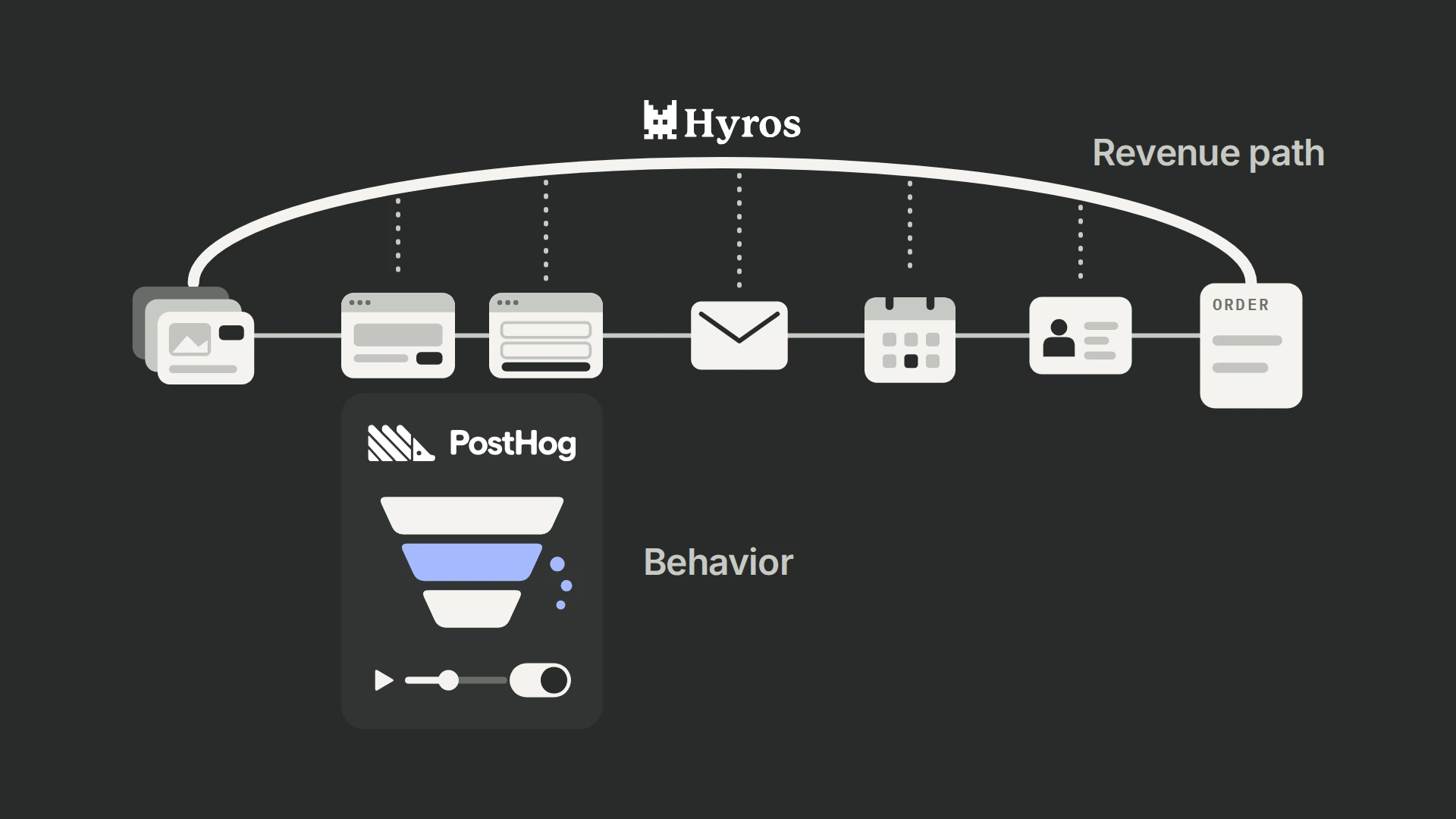
PostHog and Hyros both help you understand growth, but they are built for different decisions.
PostHog is best when you need to understand what users do on your website, app, product, onboarding flow, checkout, or experiment. Hyros is best when you need to understand which ads, emails, calls, funnels, and revenue events are actually driving profit.
That difference matters because the wrong tool can make your team optimize the wrong thing. PostHog can show that users drop off during onboarding, but it is not built to be a specialist paid-media attribution system. Hyros can show which campaigns are producing revenue, but it will not replace product analytics, session replay, feature flags, or A/B testing.
In many businesses, the right answer is not "PostHog or Hyros." It is deciding which question you need answered first, then giving each tool a clear job.
Quick Answer
Use PostHog if your main problem is product behavior, funnel analysis, session replay, feature flags, A/B testing, or event analytics.
Use Hyros if your main problem is paid-media attribution, ROAS accuracy, conversion API event quality, long sales cycles, calls, email attribution, or revenue tracking across multiple systems.
Consume both when you have a product or funnel that needs behavioral analysis and a paid acquisition engine that needs better attribution.
What PostHog Is Built For
PostHog is a product analytics and experimentation platform. It helps teams track events, build funnels, review session replays, run experiments, manage feature flags, capture surveys, monitor errors, and analyze user behavior.
That makes PostHog especially useful when the question is:
- Where are users dropping off?
- Which feature, page, or onboarding step is causing friction?
- Which experiment variant improved conversion?
- Which acquisition source produced users who actually activated?
- What did a specific user do before they converted or churned?
- Which events should we send to ad platforms after we verify they are real conversion events?
PostHog is strongest when implementation quality matters. You need clean event names, stable properties, internal-traffic filters, meaningful conversion events, and dashboards that separate population, behavior, and outcome. If your events are vague or over-captured, PostHog will still collect data, but the business decisions will be weak.
PostHog Is A Better Fit When
- You run a SaaS, app, marketplace, ecommerce site, or product-led funnel.
- You need product analytics, web analytics, funnels, session replay, feature flags, and experiments in one place.
- You have technical support from a developer, growth engineer, or analytics specialist.
- You want to validate user behavior before changing your website, product, pricing, or onboarding flow.
- You need more control over event definitions and data structure.
- You care about data residency, self-hosting, or open-source flexibility.
PostHog Is A Weaker Fit When
- Your main problem is ad-platform ROAS reconciliation.
- Your revenue happens across calls, CRMs, offline sales, payment processors, or long sales cycles.
- Your team wants a marketer-first attribution tool with less event-schema design.
- You need a specialist system to send high-quality conversion events back to Meta, Google, TikTok, or other ad platforms.
This platform can support marketing attribution through UTMs, referrers, campaign properties, and custom conversion events. But for complex paid traffic attribution, it is usually a product and behavior layer, not the entire attribution system.
What Hyros Is Built For
Hyros is an ad attribution and tracking platform. It is built for businesses that need to connect ads, funnels, emails, calls, leads, orders, subscriptions, and revenue into a clearer paid-media decision system.
That makes Hyros especially useful when the question is:
- Which campaign, ad set, creative, keyword, or source drove this sale?
- Which paid traffic should we scale or cut?
- Are Meta, Google, TikTok, GA4, and backend revenue telling different stories?
- Which conversion events should we send back to ad platforms for better optimization?
- Which calls, leads, purchases, refunds, subscriptions, or lifetime-value signals should count in reporting?
- Are our click IDs and campaign parameters being preserved through the funnel?
The Hyros is strongest when the implementation connects the full commercial journey: ad click, landing page, opt-in, VSL or webinar, email follow-up, call booking, checkout, CRM, payment processor, and revenue source.
Hyros Is A Better Fit When
- You spend enough on paid traffic that attribution errors change budget decisions.
- You sell high-ticket offers, info products, coaching, courses, ecommerce, subscriptions, or funnels with multiple conversion steps.
- You need to track revenue across ads, email, calls, CRM activity, payment processors, and recurring payments.
- You want cleaner conversion signals sent back to ad platforms.
- Your team needs campaign, creative, source, and revenue reporting more than product behavior analysis.
- You need hands-on setup support and attribution-specific implementation.
Hyros Is A Weaker Fit When
- You mainly need product analytics, feature flags, session replay, heatmaps, or A/B testing.
- Your business does not spend meaningfully on paid acquisition.
- Your funnel is simple enough that UTMs plus PostHog or GA4 answer the attribution question.
- You need self-hosting or strict control over where analytics data is stored.
This platform is not a replacement for a product analytics stack. It is a paid-media attribution and optimization layer.
PostHog vs Hyros: The Practical Comparison
| Decision area | PostHog | Hyros |
|---|---|---|
| Primary job | Product analytics, behavior analysis, experiments, feature flags, session replay | Paid-media attribution, ROAS reporting, revenue journey tracking, conversion API signals |
| Best reader/team | Product teams, founders, CRO specialists, developers, growth engineers | Media buyers, founders, agencies, ecommerce teams, high-ticket funnel operators |
| Core question | What did users do, where did they drop off, and what should we test? | Which campaigns, sources, calls, emails, and ads produced revenue? |
| Tracking model | Event-based analytics with custom event and property design | Customer journey and revenue attribution across ads, funnels, integrations, and sales systems |
| Experimentation | Native experiments and feature flags | Not the core use case |
| Session replay | Built in | Not the core use case |
| Ad attribution | Useful for UTMs, referrers, campaign analysis, and verified conversion events | Core use case, especially for multi-step paid funnels |
| Ad-platform feedback | Possible through destinations when events and properties are reliable | Core use case through conversion APIs and attribution-focused integrations |
| Pricing model | Usage-based, with a generous free tier and paid usage above limits | Paid SaaS with pricing tied to business/revenue tier and setup support |
| Setup risk | Bad event design creates noisy product data | Missing scripts, lost click IDs, duplicate revenue sources, or wrong event mapping create bad attribution |
How To Decide Which One You Need First
Do not start by asking which tool is "better." Start by writing the decision you are trying to make.
1. If The Decision Is About User Behavior, Start With PostHog
Choose PostHog first when you need to answer:
- Which step in the funnel is leaking users?
- Which landing page, checkout step, or onboarding screen causes friction?
- Which experiment variant changed behavior?
- Which users activated, retained, or dropped off?
- Which events are reliable enough to become conversion goals?
This is usually the right starting point for SaaS, apps, product-led growth, onboarding optimization, checkout optimization, and CRO teams that need to understand behavior before scaling changes.
2. If The Decision Is About Paid Spend, Start With Hyros
Choose Hyros first when you need to answer:
- Which ads are actually producing revenue?
- Which campaign should get more budget?
- Which lead source produced qualified calls or purchases?
- Which sales should be attributed to Meta, Google, TikTok, email, or organic traffic?
- Which server-side conversion events should ad platforms optimize toward?
This is usually the right starting point for paid-heavy businesses, high-ticket funnels, webinar funnels, VSL funnels, call-based sales, info products, coaching, ecommerce, and businesses where ad spend is one of the largest costs.
3. If You Need Both Product Learning And Paid Attribution, Use Both
Advanced teams often need both layers:
- PostHog for behavior: pageviews, events, funnels, session replay, experiments, feature flags, product usage, and conversion debugging.
- Hyros for attribution: ads, email, calls, purchases, subscriptions, refunds, revenue, ROAS, and ad-platform feedback.
The important part is assigning each tool a clear job. Do not make PostHog responsible for every paid attribution question if your sales journey spans ads, email, calls, CRMs, and offline decisions. Do not make Hyros responsible for product behavior analysis, experiment readouts, or feature adoption.
What You Need Before You Set Either Tool Up
Before choosing the tool, map the measurement problem.
You need:
- A list of the business decisions the data should support.
- The funnel steps from first click to final revenue.
- The platforms involved: website, app, checkout, CRM, payment processor, email platform, call-booking tool, ad platforms.
- The conversion events that actually matter.
- The identifiers that connect the journey: email, user ID, order ID, click IDs, UTMs, session IDs, customer IDs.
- The places where scripts, pixels, server events, or integrations need to be installed.
- The validation method for each important event.
If you skip this step, both tools can be "installed" while still producing misleading data.
Setup Quality: Where Each Tool Usually Breaks
Common PostHog Mistakes
- Installing the snippet on only part of the funnel.
- Relying on autocapture when semantic events are needed.
- Treating page visits as leads or purchases.
- Missing internal traffic filters.
- Using unstable button text or CSS selectors for experiment tracking.
- Changing event names without updating dashboards.
- Tracking too much and creating avoidable cost or noise.
- Forgetting to validate events in the Activity view before using dashboards.
- Sending ad-platform destinations from weak or duplicate events.
Common Hyros Mistakes
- Installing the Hyros script on some funnel pages but not all of them.
- Losing
fbclid,gclid, or Hyros URL parameters during redirects. - Connecting multiple revenue sources and creating duplicate sales.
- Mapping weak events into strong ad-platform conversion events.
- Forgetting to test calls, booked calls, email links, or recurring payments.
- Using the wrong script for the domain or funnel.
- Assuming ad-platform numbers and Hyros numbers will match perfectly without reconciliation.
- Making attribution changes during an active campaign without understanding the optimization impact.
How To Verify PostHog Is Working
In PostHog, do not stop after the snippet loads. Verify the actual events you will use for decisions.
Check:
- Pageviews appear for all important funnel pages.
- Key events fire only when the real action happens.
- Event properties include the IDs, plan names, prices, sources, and object context needed for analysis.
- UTMs and click IDs are captured on landing sessions where relevant.
- Internal, QA, preview, and staging traffic are filtered or clearly labeled.
- Funnels use meaningful behavior steps, not accidental page loads.
- Session replays are available for the pages, events, or cohorts you need to inspect.
- Experiment variants or feature flags appear on the right users.
Success looks like this: you can click into a user or session and reconstruct the journey from source to behavior to conversion without guessing what the events mean.
How To Verify Hyros Is Working
In Hyros, do not stop after the tracking script is installed. Verify the full attribution and revenue path.
Check:
- The script is present on every relevant landing page, funnel page, checkout page, upsell page, thank-you page, and confirmation page.
- Paid ad URLs preserve required click IDs and tracking parameters after redirects.
- Leads, calls, purchases, subscriptions, refunds, and other important events appear in Hyros.
- The canonical revenue source is connected once, not duplicated through multiple systems.
- Sales records can be inspected at the contact or transaction level.
- Events are sent to Meta, Google, TikTok, or other ad platforms under the intended standard event names.
- The Hyros reporting panel and ad-platform overlay are reading the same campaign/ad identifiers.
- Email, organic, influencer, call, and custom source rules produce the expected tags.
Success looks like this: you can inspect a real sale and see the source, campaign, contact journey, revenue event, and ad-platform feedback path without relying only on aggregate ROAS.
Pricing And ROI
PostHog usually has the lower barrier to entry. Its public pricing includes a free tier with monthly allowances for product analytics events, session recordings, feature flag requests, error tracking, surveys, data warehouse rows, and other products. Above the free tier, it uses usage-based pricing. That makes it attractive when you are starting analytics, building product instrumentation, or scaling gradually.
Hyros is a higher-commitment attribution platform. Its public pricing is tied to tracked monthly revenue tiers and includes setup/support positioning. That makes ROI depend less on the software price alone and more on whether better attribution changes paid-media decisions.
The practical ROI test:
- If better product analytics helps you improve activation, checkout conversion, retention, or experiment velocity, PostHog can pay for itself quickly.
- If better attribution helps you stop wasted ad spend, scale profitable campaigns, or improve conversion API optimization, Hyros can pay for itself quickly.
- If ad spend is small and the funnel is simple, Hyros may be more tool than you need.
- If product behavior is a black box, PostHog should usually come before a specialist attribution layer.
Recommended Stack By Business Type
SaaS Or App
Start with PostHog. Track activation, onboarding, feature adoption, retention, pricing-page behavior, conversion funnels, and experiments.
Add Hyros when paid acquisition becomes a major channel or when revenue attribution spans long funnels, calls, demos, trials, subscriptions, or multiple payment systems.
Ecommerce
Use PostHog when you need to understand product page behavior, add-to-cart behavior, checkout drop-off, upsells, onsite experiments, and session-level friction.
Use Hyros when paid traffic is meaningful and you need better attribution across Meta, Google, TikTok, email, SMS, subscriptions, or repeat purchases.
High-Ticket, Webinar, VSL, Coaching, Or Info Product Funnels
Hyros is usually more central because the buyer journey often crosses ads, landing pages, email, calls, DMs, webinars, order forms, manual sales, and payment processors.
PostHog still helps when you need to analyze landing page behavior, VSL engagement, checkout behavior, session replay, or conversion experiments.
Founder-Led Or Early-Stage Business
Start with the cheapest tool that answers the current decision. If you are trying to fix funnel behavior, use PostHog. If you are spending serious money on ads and cannot trust attribution, evaluate Hyros.
Do not buy an attribution platform to avoid defining your funnel. The tool will only be as useful as the implementation.
Common Misconceptions
"Hyros Is Better Than PostHog"
Not generally. Hyros is better for paid attribution. PostHog is better for product behavior, experimentation, and session-level analysis. The better tool depends on the decision.
"PostHog Cannot Do Attribution"
PostHog can do useful attribution through UTMs, referrers, campaign properties, conversion events, and custom analysis. It is often enough for simple funnels, early paid acquisition, product-led attribution, and source-level CRO analysis.
It becomes weaker when revenue happens across long sales cycles, calls, CRMs, payment processors, offline steps, subscriptions, or multiple ad platforms that need clean conversion feedback.
"Hyros Replaces GA4, PostHog, And Everything Else"
Hyros can become the core paid attribution layer, but it does not replace product analytics, event taxonomy, session replay, experimentation, feature flags, or qualitative behavior review.
"Once The Tool Is Installed, The Data Is Correct"
No. Installation is only the first step. Tracking becomes useful after scripts cover the full journey, events fire at the right semantic moment, identifiers persist, revenue is deduplicated, test traffic is excluded, and reports are reconciled against real transactions.
Decision Checklist
Use this checklist before choosing.
| Question | If yes, lean PostHog | If yes, lean Hyros |
|---|---|---|
| Do you need to understand user behavior inside a product, site, or funnel? | Yes | Not primary |
| Do you need session replay, funnels, feature flags, or A/B testing? | Yes | No |
| Do you need to know which paid ads produced revenue? | Directional only | Yes |
| Do sales happen across calls, email, CRM, payment processors, or offline steps? | Needs custom work | Yes |
| Is ad spend high enough that attribution errors change budget decisions? | Maybe | Yes |
| Do you need self-hosting or stronger data control? | Yes | No |
| Do you need marketer-friendly ROAS reporting? | Possible with setup | Yes |
| Do you need to improve activation, retention, or product conversion? | Yes | Not primary |
Final Recommendation
Choose PostHog when your growth problem is behavioral: users are dropping off, experiments need better measurement, feature adoption is unclear, conversion events are messy, or your team needs a product analytics system.
Choose Hyros when your growth problem is attribution: ad platforms disagree with backend revenue, campaigns are hard to scale confidently, sales happen across multiple touchpoints, or your conversion API signals need to be cleaner.
Use both when both problems are real. PostHog tells you what users do and what to improve. Hyros tells you which acquisition sources and campaigns deserve more budget.
The best stack is not the one with the most tools. It is the one where each tool has a clear job, the events are verified, and the reports answer decisions your team actually makes.
Frequently asked questions
Is PostHog or Hyros better?
Can PostHog replace Hyros?
Can Hyros replace PostHog?
Should SaaS companies use PostHog or Hyros?
Should ecommerce brands use PostHog or Hyros?
Is Hyros worth it if I already use PostHog and GA4?
Is PostHog enough for conversion tracking?
Which tool is easier to set up?
Which tool is better for Meta CAPI or Google Ads optimization?
Do advanced teams use PostHog and Hyros together?
Resources
- PostHog Documentation
- PostHog pricing
- Hyros documentation
- Hyros pricing
- How to Set Up A/B Testing on [WordPress, Shopify] in PostHog
- Hyros vs Facebook Attribution – Real Ad Buyer Case Study