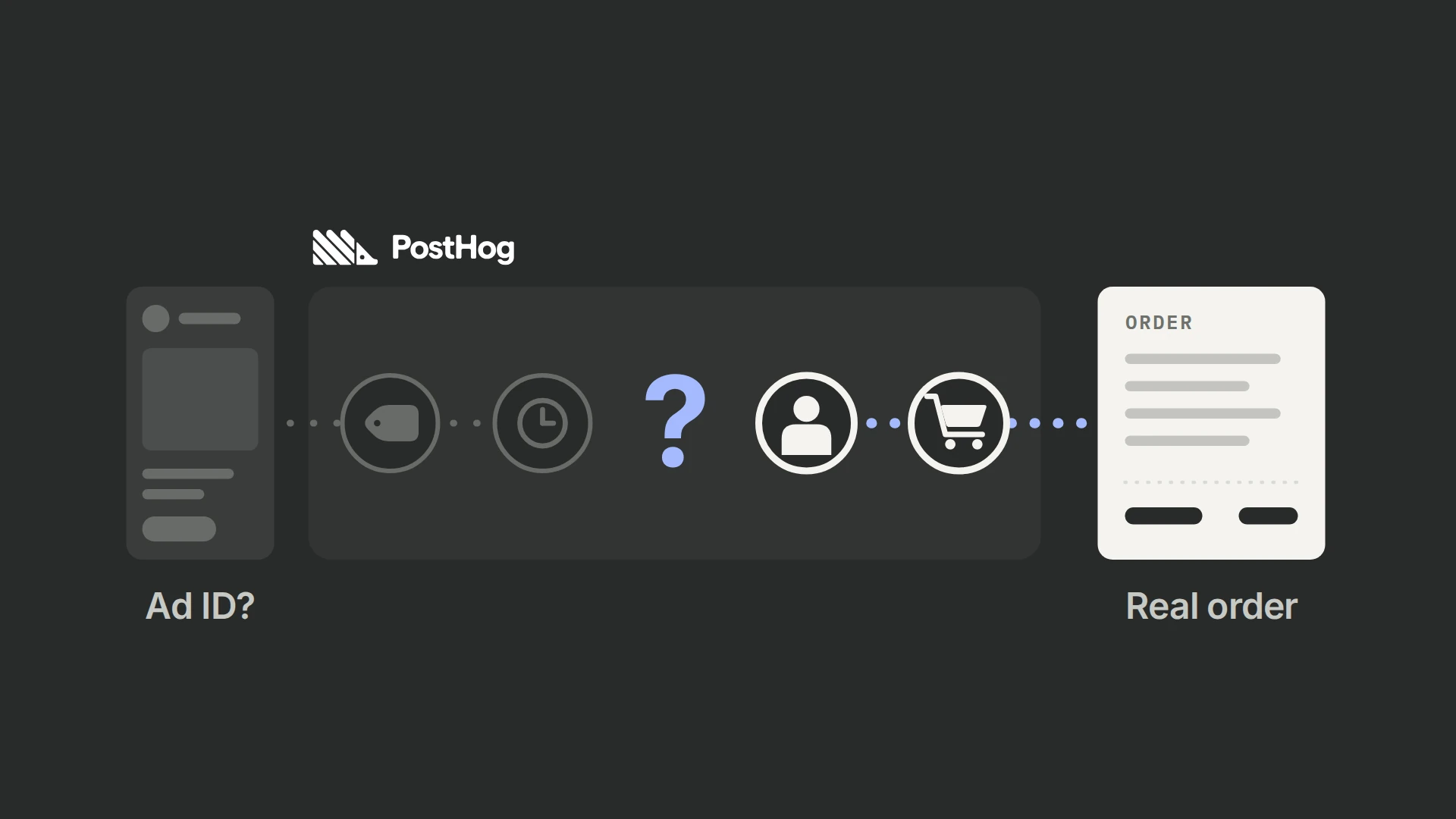

Turn PostHog data into growth decisions by finding the lever worth acting on, often where customers stop before a valuable outcome, then investigating why and testing a change that addresses it. Measure purchases, qualified sales or retained value, and deploy the change only if the result and guardrails support it; the decision loop connects those steps.
For a growth team, PostHog works best when it is wired around the decisions you need to make: finding where you lose customers, testing a specific fix, and checking whether revenue moved.
That requires more than an SDK, autocaptured clicks, session recordings, dashboards, or error reports.
A decision-ready implementation connects:
business outcome → candidate lever → measurement → intervention → exposure → realized value → next decision
Events, identity, attribution, revenue, experiments, and QA all depend on one another: if one link breaks, the final report or A/B test breaks with it.
In this guide
How to Hire a PostHog Expert
Ask candidates for a sample tracking plan, QA evidence, and an experiment decision process; the handover should let your team audit and extend the setup independently.
How to Reduce PostHog Costs
On one bill over nine months, the identified-events charge ran about 3.5 times the events charge. Cut unused capture while keeping funnels and experiments measurable.
How to Switch from Google Analytics to PostHog Without Losing Data
Switching deletes nothing in GA4. Link its BigQuery export now if you want raw history in PostHog, run both tools until the counts are explained, and move Google Ads conversions before removing GA4.
PostHog Currency Conversion and Revenue Tracking
Convert each transaction at an explicit rate date, then reconcile refunds and duplicate IDs; for experiments, revenue per participant includes nonbuyers, unlike average order value.
PostHog Setup: Account, Organization, Project, and Tracking
Choose who owns the data, keep connected journeys together, and set billing limits before traffic arrives so your new workspace does not need rebuilding later.
PostHog Skills Store: Share Agent Workflows Across Teams
Turn repeated analytics and implementation workflows into versioned skills that agents can discover and fetch on demand, with bundled files and update safeguards instead of copied prompts.
PostHog vs GA4: Analyst’s Guide
PostHog is usually better suited than the GA4 reporting interface to be the operational source of truth for growth decisions. It provides direct event-level investigation, explicit identity, flexible SQL, behavioral analysis, and experimentation in one environment. GA4 remains valuable for standardized acquisition and Google Ads reporting; when raw GA4 data is modeled in BigQuery, the warehouse becomes the real source of truth.
PostHog vs Hyros: Which Tracking Tool Fits Best?
Choose by the decision: PostHog explains on-site behavior and experiments; Hyros traces paid spend through calls, CRM, and revenue. Simple funnels may need only PostHog.
PostHog vs Segment: Analyst’s Guide
If the gap is understanding behavior and running tests, PostHog fits; if it is governing and routing customer data across tools, Segment fits. Some teams use both.
PostHog should implement the growth decision loop
99Ways uses Growth Lever Analytics for a practical sequence:
- Find the controllable variable worth acting on.
- Make it measurable.
- Act through a specific intervention.
- Validate the effect.
- Use the result to choose what to do next.
PostHog is useful when its implementation supports that loop.
| Growth stage | Decision the team must make | PostHog requirement | Evidence produced |
|---|---|---|---|
| Find the lever | Where is value being lost, for whom, and through which mechanism? | Meaningful events, valid identity, source context, outcome data, funnels, SQL, and behavioral evidence | Ranked opportunity with an explicit mechanism |
| Make it measurable | What must be observed to judge the lever? | Event and metric contracts, stable IDs, authoritative outcome events, attribution and revenue continuity | Trusted baseline and analysis specification |
| Act | What change will express the hypothesis? | Treatment implementation, feature flag or rollout logic, eligibility, ownership, and launch controls | A testable intervention |
| Validate | Did the intervention cause a commercially useful result? | Stable assignment, meaningful exposure, primary and guardrail metrics, downstream outcomes, and valid analysis | Deploy, revise, reject, or continue decision |
| Learn | What changes permanently, and what should be tested next? | Verified deployment, monitoring, decision log, and cumulative impact reporting | New baseline and next ranked lever |
PostHog does not choose the business objective or invent a useful hypothesis. It supplies the evidence and operating controls needed to make those decisions accountable.
Start with one decision, not every PostHog feature
Implementation should begin with a decision inventory.
For each priority decision, define:
- the business outcome;
- the population or entity affected;
- the candidate mechanism;
- the intervention the business can make;
- the primary metric;
- downstream guardrails;
- the authoritative system for the outcome; and
- the evidence required to deploy or reject the change.
Suppose an ecommerce team suspects that unclear pricing and delivery expectations reduce completed purchases.
Write down the commercial question you actually need to answer on the product page:
Determine whether explaining total cost and delivery conditions earlier increases refund-adjusted revenue per eligible visitor without increasing cancellations or support burden.
That decision creates concrete implementation requirements:
- eligible product-page visitors;
- acquisition and landing context;
- meaningful exposure to the current or revised explanation;
- product, cart, checkout, and purchase events;
- order ID, amount, currency, and product context;
- refunds and cancellations;
- identity or session continuity between the page and backend purchase;
- an experiment exposure event;
- a primary metric based on realized value; and
- guardrails for refund or cancellation behavior.
Starting from the decision prevents two common errors: tracking everything that is technically available, and building dashboards before the business definitions exist.
Business-aware events make the lever observable
Tracking hundreds of raw clicks rarely helps a team make better decisions.
Events should represent state changes, meaningful behavior, and business outcomes that help explain the decision. For each critical event, the implementation must establish:
- Meaning: What fact does the event assert?
- Trigger: What exact state transition makes the assertion true?
- Authority: Should the browser, application, backend, webhook, CRM, or billing system assert it?
- Entity: Which person, account, session, order, subscription, product, or other object does it concern?
- Properties: Which IDs, values, categories, versions, sources, and context are required to analyze it?
- Multiplicity: Can it occur repeatedly, or should it be unique per transaction or entity?
- Downstream use: Which metric, funnel, cohort, experiment, or reconciliation depends on it?
- QA: What evidence proves the event works in success, failure, retry, and edge cases?
A button click only shows intent, and a thank-you-page view only shows that a URL loaded. Record completed purchases from the payment processor or backend that actually settled the order, keyed by a unique transaction ID so you can deduplicate retries and match totals against finance.
PostHog currently supports defining typed event schemas and reusable property groups before events are captured. Its documentation describes upfront event definitions, required typed properties, owners, and generated types, while also labeling the schema-management feature experimental. Use that capability as an implementation aid, not as a substitute for a business-owned tracking specification. (PostHog schema management)
The complete design method belongs in Event Tracking Plan for CRO and Product Analytics. The implementation article needs only one standard:
An event belongs in the system when its meaning, trigger, identity, properties, authority, and analytical use are explicit.
Match user identity to the decisions you make
User identity is how PostHog connects what someone saw early in the journey to whether they eventually paid or renewed.
A growth implementation may need several distinct identities:
| Identity | What it connects | When it matters |
|---|---|---|
| Anonymous visitor or device | Pre-signup behavior and acquisition context | Landing pages, anonymous funnels, pre-auth experiments |
| Known person | Behavior across authenticated sessions | Lead journeys, subscriptions, retention, customer-level value |
| Account or organization | Several users acting for one customer entity | B2B activation, account retention, expansion |
| Session | Actions within one visit or product-use period | Session funnels, replay, source-entry analysis |
| Transaction, order, or invoice | One authoritative commercial outcome | Revenue, refunds, deduplication, reconciliation |
| Subscription or opportunity | A lifecycle spanning several events | Renewals, churn, sales stages, recurring value |
| Experiment unit | The object assigned to treatment | User-, account-, device-, market-, or session-randomized tests |
Not every company needs every identity. Complexity is justified only when the decision requires it.
For a simple anonymous landing-page test, a stable browser identity may be sufficient. A subscription business that starts on the web, continues in an app, and measures renewals needs a stronger person, session, and subscription model. A B2B product may need account-level grouping because individual user activity is not the commercial unit.
PostHog assigns an anonymous ID and lets the implementation call identify() when a stable known ID becomes available. Its documentation emphasizes using the same distinct_id for frontend and backend events and resetting identity on logout. It also notes that server-side events should receive the same person ID deliberately. (PostHog user identification)
Treat session continuity as a separate requirement
Session continuity is separate. PostHog’s browser and mobile SDKs add $session_id, while server SDKs do not send it by default. When a backend purchase belongs to a frontend journey, the implementation should pass the original session ID if session-level analysis or replay linkage is required. (PostHog sessions)
The identity acceptance test is straightforward:
Can the team take one outcome and explain, without guesswork, why it belongs to this visitor, customer, account, session, source, and experiment assignment?
If not, the architecture may still support aggregate analysis, but it should not claim person-level continuity it cannot prove.
Attribution and revenue must survive the full journey
A conversion rate is commercially useful only when the team knows which population entered the denominator and which business value entered the numerator.
The acquisition chain may pass through:
ad → landing page → another domain → form or signup → app or checkout → backend payment → refund or renewal
Each transition can lose context.
PostHog automatically captures standard UTM parameters on events, as initial and latest person properties, and as session-entry properties. It also captures related referrer and entry properties. (PostHog UTM segmentation)
Automatic capture solves the first collection step. It does not guarantee end-to-end attribution.
The implementation must still decide:
- which source dimensions matter;
- whether the business needs source, campaign, ad set, ad, keyword, affiliate, or click IDs;
- how first-touch, session-entry, and latest-touch context differ;
- how parameters survive redirects and domain changes;
- how anonymous source context joins to a known user;
- how backend outcomes receive the relevant person, session, and transaction IDs;
- which attribution rule the query applies; and
- how spend data matches the same campaign or ad identifiers.
Use the existing 99Ways UTM guidelines for naming and link construction. The PostHog implementation should enforce the agreed acquisition contract rather than inventing a second convention inside dashboards.
Define a separate revenue contract
Revenue requires a parallel contract.
For purchases, subscriptions, and lead-generation sales, define:
- authoritative system;
- transaction, order, invoice, lead, or subscription ID;
- event timestamp and business status;
- amount and currency;
- gross, net, tax, shipping, discount, and contribution treatment where relevant;
- products, plans, or line items;
- refund, cancellation, chargeback, renewal, and payment-failure behavior;
- browser/server authority;
- deduplication rule; and
- reporting horizon.
PostHog’s SQL and data warehouse can query product events alongside synced sources such as Stripe, Postgres, Salesforce, or HubSpot. This can keep behavioral evidence and authoritative commercial data in one query layer, but the operational system remains the source of record for the transaction. (PostHog SQL, PostHog data warehouse)
Attribution is observational. It assigns recorded value under a rule. It does not prove how much revenue the advertising caused. Experimentation or other causal designs are required for incremental claims.
Build diagnostic views after the data model is valid
Funnels, trends, cohorts, paths, SQL, session replay, and error tracking only give reliable answers once the underlying events and IDs are solid.
A Growth Lever Team should build only views that correspond to a decision.
Useful examples include:
- acquisition source to realized purchase or qualified sale;
- eligible visitor to purchase, segmented by source, device, market, or product;
- onboarding entry to activation and retained use;
- trial to conversion, renewal, cancellation, and net value;
- experiment exposure to primary outcome and guardrails;
- error occurrence to affected funnel step and lost business outcome;
- behavioral sequence among customers who converted versus comparable users who did not.
Each view needs a metric contract:
- entity being counted;
- eligible population;
- numerator and denominator;
- event and property definitions;
- time field and timezone;
- conversion or attribution window;
- deduplication;
- exclusions;
- revenue treatment; and
- expected reconciliation.
PostHog supports SQL over events and persons and can query external sources in the same environment. That makes it possible to move from a standard funnel to a decision-specific query when the business question exceeds a predefined report. (PostHog SQL access)
Session replay can help explain a mechanism: confusion, hesitation, errors, repeated attempts, or unexpected navigation. It should not be used to estimate prevalence by watching a handful of sessions.
Error tracking can identify a technical candidate lever: a payment error, broken device path, or slow component. It does not establish the economic exposure or prove that fixing the error will create the largest return.
Before prioritizing a fix, weigh how many users hit the issue, which segment they belong to, and how much revenue is at stake, so one dramatic session recording or error log does not hijack the roadmap.
Build A/B testing into the initial tracking setup
A business lever is a controllable mechanism such as pricing clarity, qualification friction, onboarding sequence, payment reliability, or offer framing.
An experiment is the controlled operating mechanism used to act on that lever and estimate the effect of the intervention.
For example:
- Candidate lever: uncertainty about total price.
- Intervention: show total cost and delivery conditions before checkout.
- Experiment: randomly assign eligible visitors to current or revised information.
- Primary outcome: refund-adjusted revenue per eligible visitor.
- Guardrails: cancellation rate, support contacts, payment errors, and page performance.
- Decision: deploy, revise, reject, or investigate a segment.
This is why experimentation must be designed into the implementation, not added after the dashboards are finished.
PostHog’s experiments use the same events, warehouse tables, and feature flags already in the project. A feature flag assigns variants and records exposure; post-exposure events become funnel, mean, ratio, or retention metrics. (PostHog experiments, PostHog experiment metrics)
That integration is valuable only when the upstream system is correct.
Define experiment readiness before launch
Experiment readiness requires:
- Eligibility: Only the population relevant to the decision can enter.
- Assignment unit: The user, account, device, session, or other unit matches the decision.
- Persistence: The unit remains in the same variant across identity transitions and the outcome window.
- Treatment delivery: The assigned experience is actually rendered or executed.
- Meaningful exposure: The user reaches the point where the intervention can affect behavior.
- Primary metric: The metric represents the business outcome closely enough for the decision.
- Guardrails: Downstream quality, revenue, risk, or performance cannot deteriorate silently.
- Reconciliation: Experiment outcomes match the underlying business events.
- Deployment: A validated change is implemented permanently and verified.
- Learning: The result changes the opportunity map or next hypothesis.
Treat exposure as an implementation decision
PostHog defines exposure as the moment a user encounters the experimental part of the product. Its default feature-flag exposure works for many cases, but the documentation recommends custom exposure events when the team needs more precise control and advises placing exposure where users actually encounter the change. (PostHog experiment exposures)
A flag evaluation at application startup is not necessarily exposure to a later onboarding screen. A user assigned before signup may change identity before purchase. An exposure denominator may include existing customers who were never eligible for the outcome. Those are tracking bugs, and no statistical test can fix them afterward.
For the complete trust chain - including assignment, sample-ratio mismatch, crossover, exposure, denominators, and the Zero Experiment - use the Experimentation System Audit.
Not every lever can be tested with a conventional A/B experiment. Low volume, market-level changes, operational interventions, and one-time strategic decisions may require staged rollouts, holdouts, or qualified observational evidence. The confidence of the decision should match the design.
QA must prove the decision chain, not only event delivery
Seeing an event in PostHog proves that a payload arrived. It does not prove the event is true, joined correctly, counted once, attributed correctly, or suitable for the metric.
A serious implementation should pass five classes of acceptance test.
| Acceptance test | Required proof |
|---|---|
| Event-contract test | The event fires at the exact success boundary, includes required typed properties, excludes failures, and handles retries correctly. |
| Identity-continuity test | An anonymous visit becomes the correct known user, and frontend, backend, session, account, and transaction IDs join as designed. |
| Acquisition-to-value test | A real landing source or ad identifier can be traced through the journey to an authoritative purchase, sale, or subscription outcome. |
| Experiment test | Eligible users receive stable assignments, meaningful exposures, correct variants, and post-exposure business metrics. |
| Reconciliation test | Transaction counts, values, refunds, renewals, and important funnel totals agree with systems of record within documented, explained coverage. |
The strongest production test starts with a real outcome in the system of record and traces backward:
authoritative purchase → PostHog event → transaction ID → person → session → journey → source → experiment exposure
Then repeat the validation in aggregate.
The implementation should also test:
- staging and production;
- supported devices and app versions;
- consent states;
- cross-domain and checkout transitions;
- browser and server duplication;
- failed and retried payments;
- refunds and renewals;
- internal, bot, and QA traffic;
- logout and shared-device behavior;
- delayed or out-of-order events; and
- releases that change event or identity logic.
This is where implementation ends and continuous reliability begins. The detailed production validation method belongs in PostHog Audit: 12 Checks Before You Trust the Data. For the wider measurement chain across analytics, advertising, CRM, and operational systems, use the Conversion Tracking Audit.
A staged PostHog implementation for Growth Lever Teams
The dependency order matters. Dashboards and experiments built before the event, identity, and commercial model are stable become expensive rework.
Phase 1: Define the decisions and business model
Produce:
- priority decision inventory;
- business outcomes and equations;
- candidate lever map;
- systems of record;
- primary and guardrail metrics; and
- use-case-specific trust requirements.
Decision gate:
Can the team state what decision each requested metric will support?
Phase 2: Specify events, entities, identity, and metrics
Produce:
- event tracking plan;
- entity and identity map;
- event and property contracts;
- attribution property contract;
- transaction and lifecycle model;
- metric and query contracts;
- collection authority by client, server, webhook, CRM, or billing system; and
- QA cases.
Decision gate:
Can engineering implement the plan without inventing semantics?
Phase 3: Instrument acquisition, behavior, and value
Implement:
- client and server SDKs where appropriate;
- semantic events and typed properties;
- anonymous-to-known identity;
- group or account identity where required;
- session continuity where required;
- UTM, click-ID, landing, and referrer capture;
- backend purchases and lifecycle events;
- transaction deduplication;
- source integrations and warehouse tables; and
- internal/test traffic controls.
Decision gate:
Can one real journey be traced from entry to authoritative outcome?
Phase 4: Build core funnels and diagnostic dashboards
Build:
- baseline funnels;
- source-to-value views;
- segment diagnostics;
- cohorts and retention;
- SQL models for business-specific metrics;
- replay and error views linked to decision populations; and
- documented dashboards with owners.
Decision gate:
Can another analyst reproduce the key metric from its definition?
Phase 5: Make the system experiment-ready
Implement and verify:
- feature-flag ownership and lifecycle;
- assignment unit and eligibility;
- assignment persistence;
- meaningful exposure events;
- experiment metric definitions;
- primary and guardrail outcomes;
- conversion windows;
- traffic and interaction constraints;
- sample-ratio and contamination monitoring; and
- permanent deployment and flag-removal process.
Decision gate:
Can the team run one experiment whose treatment, exposure, outcome, and deployment are independently auditable?
Phase 6: Reconcile, monitor, and hand over
Deliver:
- event and identity QA evidence;
- source-to-outcome traces;
- revenue and lifecycle reconciliation;
- implementation defect log;
- monitoring and alert rules;
- event and dashboard ownership;
- schema change process;
- deployment verification;
- decision log; and
- operating cadence.
Decision gate:
Will the team notice when a release or integration silently changes the meaning of a metric?
What "done" means
A Growth Lever PostHog implementation is done only when the team can demonstrate all of the following:
- Decision clarity: Every critical dashboard and metric has an owner, definition, and business decision.
- Event truth: Critical events assert real state changes at documented trigger points.
- Identity sufficiency: The identities required for the decision remain connected through the outcome window.
- Commercial continuity: Acquisition and realized value can be joined and reconciled at the required granularity.
- Diagnostic usefulness: Reports show which user segments drop off and point to likely causes beyond top-line totals.
- Experiment readiness: A controlled treatment can preserve eligibility, assignment, exposure, outcome, and guardrails.
- Reproducibility: Key results can be rebuilt from documented queries and definitions.
- Deployment closure: Validated changes are implemented, verified, and included in cumulative impact reporting.
- Operational ownership: Schema changes, integrations, alerts, flags, and dashboards have responsible owners.
- Drift detection: Breakage becomes visible before it silently changes a strategic decision.
Turning on every PostHog toggle does not mean the setup is done.
Common implementation anti-patterns
"Track everything now; decide later"
This creates event volume without semantic trust. Begin with high-value decisions and expand only when new questions justify new data.
"Autocapture is the tracking plan"
Autocapture is useful for exploratory behavior and debugging. Critical state transitions, outcomes, identities, and business properties need explicit contracts.
"Session replay tells us what users want"
Replay can reveal mechanisms and implementation defects. It does not provide a representative estimate of prevalence or causal effect by itself.
"The error tracker found the growth lever"
An error may be commercially important. Rank it by affected population, funnel location, value exposure, and evidence that resolving it changes the outcome.
"The purchase page loaded, so revenue is tracked"
Use authoritative backend or commerce events, stable transaction IDs, values, currencies, and refund or renewal lifecycle data.
"The feature flag split the traffic, so the experiment is valid"
Assignment is only one step. Identity persistence, treatment delivery, meaningful exposure, eligibility, outcomes, denominators, and analysis must also be correct.
"The winning variation can stay in the feature flag forever"
Feature flags are temporary control infrastructure. A validated change should normally be implemented in the product’s durable source of truth, verified, and the obsolete flag retired under an owner.
"The dashboard is the source of truth"
The dashboard is a representation. The source of truth is the documented lineage from authoritative business facts through event, identity, query, and decision.
What PostHog implementation cannot solve
A strong implementation cannot compensate for:
- an unclear business objective;
- a product or offer with no credible demand;
- an intervention the team cannot implement;
- traffic too sparse for the intended experiment;
- outcomes that mature outside the available observation window;
- consent, browser, device, or offline gaps that make complete attribution impossible;
- causal claims based only on observational reports;
- inconsistent operational systems;
- a team that does not deploy validated changes; or
- no ownership after handover.
PostHog can show you where your data has gaps, though it still relies on events your systems actually capture.
Frequently asked questions
What is a PostHog implementation?
A PostHog implementation is the design, instrumentation, integration, validation, and operating process that connects business questions to events, identity, acquisition, outcomes, queries, experiments, and decisions.
Installing the snippet is just the first technical step.
What makes a PostHog implementation useful for growth teams?
It must help the team identify where value is being lost, understand the affected population and mechanism, implement an intervention, and measure whether the change improved a business outcome.
A useful implementation therefore connects behavior to acquisition, identity, revenue, and experiments rather than stopping at traffic or clicks.
What is a Growth Lever Team?
Growth Lever Team is 99Ways’ term for a team that selects controllable growth mechanisms, makes them measurable, acts through specific interventions, and validates the outcome.
The term describes an operating method, not a PostHog feature or established software category.
Do I need an event tracking plan before implementing PostHog?
Yes for decision-critical events.
The plan defines event meanings, triggers, properties, identities, authoritative sources, metric uses, and QA. It prevents engineering and analytics teams from inventing incompatible definitions during implementation.
How should identity be designed in PostHog?
Use the minimum identity architecture required by the decision.
At minimum, define how anonymous activity becomes known, which immutable person or account IDs are canonical, how frontend and backend events use the same IDs, when sessions matter, how logout/reset behaves, and which transaction or lifecycle IDs support joins and reconciliation.
Can PostHog track marketing attribution and revenue?
Yes, when acquisition identifiers, identity, authoritative revenue events, transaction IDs, cost data, and attribution rules are implemented deliberately.
PostHog automatically captures standard UTMs, but automatic landing capture does not guarantee that source context survives every domain, application, checkout, identity, and backend transition.
Why should experiments be part of the implementation?
Experiments reuse the event, identity, revenue, and metric model.
If those layers are not designed for eligibility, stable assignment, meaningful exposure, guardrails, and downstream outcomes, the team may be able to launch a feature flag without being able to trust the result.
Is session replay enough for conversion optimization?
No.
Replay can reveal confusion, errors, hesitation, and unexpected behavior. Quantitative events and outcomes are required to estimate scale and value. Controlled experiments or another causal design are required to estimate the effect of a change.
How do I know whether a PostHog implementation is complete?
Trace one authoritative business outcome backward through PostHog to the correct transaction, person, session, journey, source, and experiment exposure. Reproduce the aggregate metric, reconcile it with the system of record, and demonstrate that the team can detect drift after a release.
How long does a PostHog implementation take?
There is no defensible universal duration.
Scope depends on the number of domains, applications, identities, systems of record, acquisition channels, lifecycle events, existing defects, engineering capacity, and experiment requirements. Estimate from the dependency map and acceptance tests, not from the SDK installation time.
The next useful decision
When PostHog is installed and your team still needs an auditable path from acquisition to realized revenue and experiment outcomes, start with the implementation architecture.
Use PostHog Audit: 12 Checks Before You Trust the Data to isolate broken dependencies, or see what to expect when hiring a PostHog expert when scoping external support.