
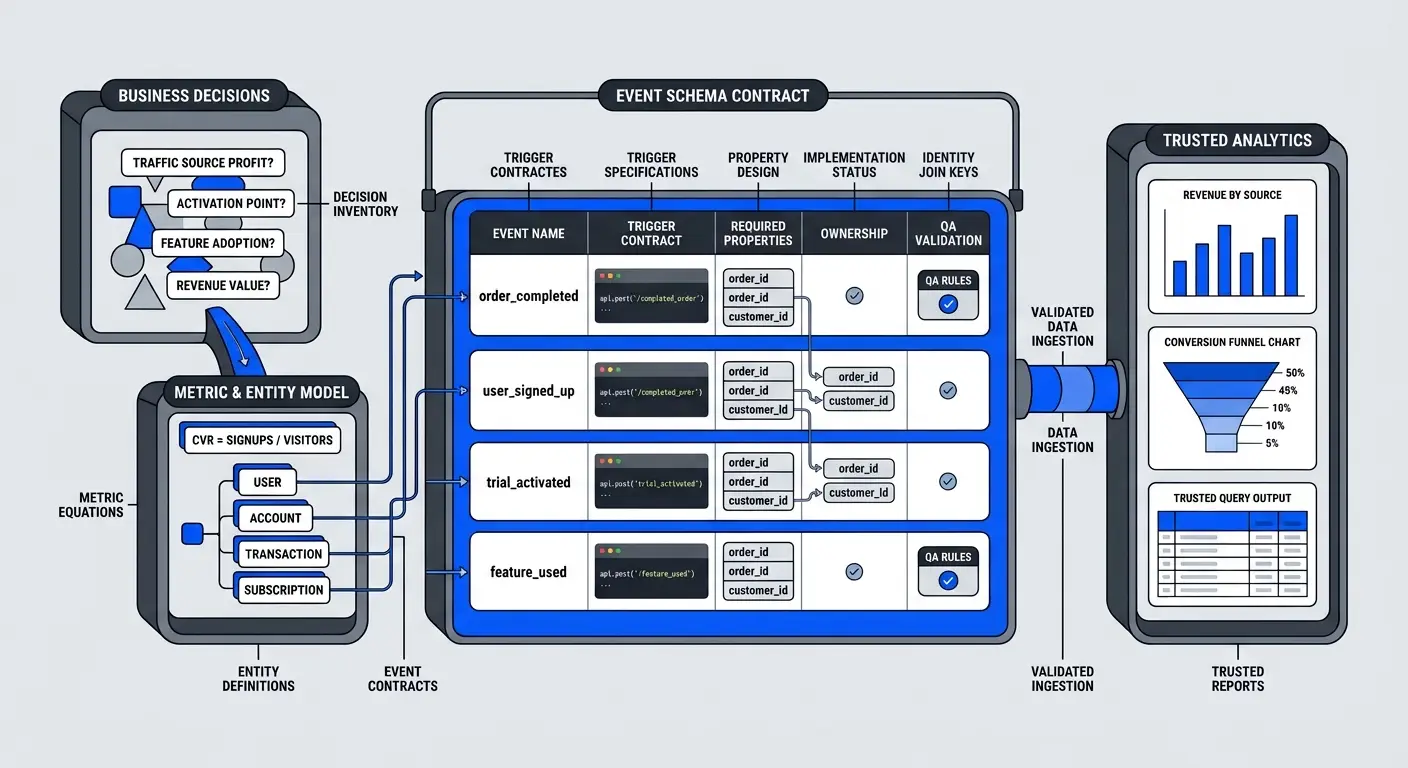
An event tracking plan is the contract that defines how real business behavior becomes analytics data.
A useful plan does more than list event names. It specifies the business question, entities, event meaning, exact trigger, required properties, identity and join keys, acquisition context, authoritative source, downstream metric, QA evidence, owner, and change history.
The design sequence should run backward from the decision:
Business question -> entities and lifecycle states -> events -> trigger contracts -> properties -> identity and join keys -> acquisition context -> revenue events -> metric and query definitions -> QA -> governance
If engineering still has to decide what trial_started means while writing the code, the tracking plan is not finished. If an analyst later has to guess which event, ID, window, or revenue field belongs in the query, it is not finished either.
The downloadable 99ways Event Tracking Plan Template follows the same structure and includes example rows for the subscription journey used throughout this article.
What is an event tracking plan?
An event tracking plan is a shared implementation specification for analytics data.
At minimum, it answers four questions:
- Why are we collecting this data? Which business decision or metric depends on it?
- What fact are we asserting? Which event, entity, state, or property represents that fact?
- How will the fact be produced? What exact trigger, source system, identity, and schema create the data?
- How will we prove it works? Which QA case, query, and system-of-record check validates the implementation?
Amplitude’s current tracking-plan documentation makes the same basic distinction: a plan defines events and properties, why they are collected, and which source emits them; required properties can also have explicit types and validation rules. Segment describes a tracking plan as the central reference for what is tracked, where it is tracked, and why. Snowplow’s Event Studio adds schema versioning, entities, ownership, and governance to the same idea.
Those tools differ. The contract does not.
A spreadsheet can be enough for a small team. A larger team may encode the same contract in Amplitude Data, Segment Protocols, Snowplow Event Studio, PostHog schemas, a repository schema, or a custom data catalogue. The important part is that the specification exists before the data is treated as trustworthy.
Start with the business question, not the interface
The first row of a tracking plan should not be button_clicked.
Start with a decision the business needs to make.
We will use one example throughout this article: a subscription business buying paid traffic.
Its primary question is:
Which paid acquisition sources create subscribers who activate, pay, renew, and produce enough realized value to justify more spend?
Secondary questions follow naturally:
- Where does the paid journey lose the most commercially valuable users?
- Which behaviors before payment predict later renewal?
- Does the trial produce customers who remain valuable after the first payment?
- Which campaign, ad, or landing context produced the customer?
- Which subscription outcomes should be sent back to advertising platforms?
Now the tracking plan has a purpose.
A useful decision inventory contains:
| Field | Example |
|---|---|
| Business question | Which paid sources produce retained subscription value? |
| Decision | Increase, reduce, or redirect acquisition spend |
| Eligible population | New visitors entering from paid campaigns |
| Economic outcome | Refund-adjusted subscription value per eligible visitor over a defined horizon |
| Diagnostic questions | Signup, trial, activation, payment, renewal, cancellation, refund |
| Required breakdowns | Source, campaign, ad, landing page, device, plan |
| Systems of record | Product database, billing provider, ad platforms |
This prevents the event schema from becoming an inventory of whatever the interface makes easy to track.
The same principle appears in Amplitude’s data-planning guidance: define business objectives, break them into key metrics, then identify the events and properties required to measure them. Segment similarly recommends beginning with questions the business wants to answer.
Model entities and lifecycle states before choosing events
Events describe changes. Entities are the things changing.
Before naming events, list the business objects that need stable identities and the lifecycle states that matter.
For the subscription example:
| Entity | Example identity | Relevant lifecycle |
|---|---|---|
| Anonymous visitor | anonymous_id or analytics distinct ID | first seen -> known or lost |
| User | internal user_id | created -> activated -> inactive |
| Session | session_id | entered -> active -> ended |
| Campaign / ad | platform campaign and ad IDs | active -> paused / ended |
| Subscription | subscription_id | trial -> active -> cancelling -> ended |
| Payment transaction | transaction_id | attempted -> succeeded / failed -> refunded |
| Plan | stable plan_id | available -> deprecated |
This step does two things.
First, it reveals the joins the eventual queries require. If the business wants to connect a payment to the original landing source, the plan needs a path from transaction -> subscription -> user -> original acquisition context.
Second, it separates state from state change.
A subscription can have a current property such as subscription_status = active. That property describes the latest state. Events such as trial_started, payment_succeeded, cancellation_requested, and subscription_ended describe transitions through time.
You usually need both forms for different questions.
Do not encode the same concept inconsistently as a person property in one system, an event name in another, and a free-text status somewhere else without a defined relationship.
Choose events that represent meaningful facts
A useful event should assert something the business would be willing to define precisely.
For our subscription journey, the core event set might be:
page_viewed;signup_completed;trial_started;- the underlying product events required to derive activation;
payment_succeeded;payment_failedwhen operationally useful;refund_issued;cancellation_requested; andsubscription_ended.
You may not need a separate subscription_renewed event if a successful recurring payment_succeeded event with billing_reason = renewal already contains the full fact. If analysts constantly need renewal as a named lifecycle event, a derived semantic event or explicit event can still be justified. The tracking plan should make the relationship explicit so both are not counted as independent revenue.
Do not create events for facts you cannot observe
The website normally does not observe the ad click itself. It observes the landing request and its acquisition parameters.
Calling that event ad_clicked would assert a fact your product did not directly observe.
Use the landing event plus source properties such as campaign ID, ad ID, click ID, referrer, and landing URL. The ad platform remains the authoritative source for the click and spend.
Distinguish intent from completion
A button tap and a completed business outcome are different facts.
Examples:
signup_button_clickedis intent.signup_completedis successful account creation.checkout_submittedis a client action.payment_succeededis a financial success.cancel_button_clickedis intent.cancellation_requestedmeans the subscription state changed.subscription_endedmeans access actually ended.
Track the intent event when it helps diagnose behavior. Do not let it impersonate the outcome.
Event volume is not event quality
In one 99ways app analytics audit, a large event inventory contained high-volume events that still had false-positive risks, overlapping semantics, missing object IDs, and unclear completion boundaries.
For example, one program-completion event overlapped with a progress-saving event, several step events lacked stable step_id and day_number fields, and a generic community event combined behaviors that later needed separate analysis.
The system was collecting a lot of data. That did not mean the data model was answering clean questions.
Use one event naming convention consistently
There is no universal winner between order_completed, completed_order, or Order Completed.
Consistency matters more than personal taste.
For the downloadable template, 99ways recommends:
`object_action` in lowercase snake_case, with the action expressed as a completed state or precise transition.
Examples:
signup_completedtrial_startedactivation_achievedpayment_succeededrefund_issuedcancellation_requestedsubscription_ended
This convention is readable, predictable, and groups related lifecycle events naturally.
Amplitude’s default taxonomy examples use the same conceptual pattern in a different display style: noun plus past-tense verb, such as Order Completed. The important rule is to choose a vocabulary and stop creating synonyms.
Avoid:
signup,sign_up,user_signed_up, andregistration_completefor the same fact;- names that encode variable data such as
purchased_pro_planwhenpayment_succeeded+plan_id = prois cleaner; - ambiguous names such as
engaged,success,completed, orconvertedwithout an object; - silently changing an event’s meaning while preserving the same name.
If semantics materially change, version the contract or create a new event. Do not make historical data mean two different things under one label.
Write trigger contracts that make event names true
The trigger is where most tracking plans become real or collapse into ambiguity.
A trigger contract should define:
- preconditions;
- exact success boundary;
- actor and object;
- source application or backend;
- when the event fires;
- when it must not fire;
- whether it may repeat;
- retry behavior;
- uniqueness / idempotency;
- expected ordering; and
- authoritative source.
Example: trial_started
Weak trigger:
User starts a trial.
Implementable trigger:
Emit
trial_startedonce when the billing system successfully creates a subscription whose current billing state is trialing. Do not emit on paywall view, plan selection, checkout submit, payment-method entry, failed subscription creation, or page redirect. Use the billing subscription ID as the uniqueness key. Webhook retries must not create additional logical trial-start records.
That definition tells engineering what fact must exist before the event can be true.
Example: activation_achieved
Activation is usually a business rule rather than one UI interaction.
Suppose the team defines activation as:
A new user completes their first program step within seven days of signup.
The tracking plan should specify:
- the underlying event that proves a program step was completed;
- stable
program_idandstep_idfields; - signup timestamp source;
- the seven-day window;
- whether activation is computed in a query or emitted once as a derived event; and
- an
activation_definition_versionif the rule is likely to evolve.
The word activation should never become a shortcut for an undocumented analyst formula.
Example: payment_succeeded
A browser thank-you page is not enough.
A stronger contract is:
Emit one logical
payment_succeededfact when the authoritative billing or commerce system confirms a captured or successfully settled transaction. Include a stable transaction ID, user/customer ID, subscription ID where relevant, amount, currency, plan/product context, billing reason, and source system. Retries must preserve the same transaction key.
The exact payment state depends on the billing architecture. The point is to define it before implementation.
Design properties as part of the event contract
Events tell you what happened. Properties tell you which object, context, version, source, and value were involved.
For every important property, define:
- exact name;
- meaning;
- data type;
- required or optional status;
- allowed values or enum;
- example value;
- source system;
- whether it describes the event at that moment or current entity state; and
- privacy / sensitivity classification where relevant.
For payment_succeeded, useful event properties could include:
| Property | Type | Why it exists |
|---|---|---|
transaction_id | string | Deduplication and reconciliation |
subscription_id | string | Join payment to subscription lifecycle |
user_id | string | Join backend value to known user |
plan_id | string | Analyze plan economics |
amount | number | Financial calculation |
currency | string enum / ISO code | Prevent mixed-currency totals |
billing_reason | string enum | Initial payment vs renewal vs other |
payment_sequence | integer | Renewal / lifecycle analysis |
source_system | string enum | Data lineage |
environment | string enum | Exclude test / staging data |
Preserve historical context on the event when history matters
A current user property such as current_plan = pro changes over time.
If you want to know which plan the customer was on when a payment occurred, store plan_id on the payment event itself or make sure it can be joined to a historical entity record.
Do not rely on today’s person property to reconstruct yesterday’s event context unless the underlying system preserves history.
Do not overload one property
A property called type should not mean plan type on one event, content type on another, and payment type on a third.
Prefer explicit names:
plan_typecontent_typepayment_method_type
The goal is a schema an analyst can query without tribal knowledge.
Define identity and join keys after the event schema has a purpose
Identity should be as complex as the decision requires, not as complex as the analytics platform permits.
For our subscription example, the join path may be:
anonymous_id -> user_id -> subscription_id -> transaction_id
Acquisition context may also connect through session_id, first-touch properties, or a dedicated attribution table.
A practical identity map should specify:
| Key | Created by | Stable? | Purpose |
|---|---|---|---|
anonymous_id | analytics client | browser / install dependent | pre-signup behavior |
user_id | application database | yes | canonical known person |
session_id | analytics client or app | session-scoped | journey grouping |
subscription_id | billing system | yes for subscription | lifecycle joins |
transaction_id | billing / commerce system | yes for transaction | revenue and deduplication |
| campaign / ad ID | ad platform | stable within platform | acquisition joins |
Prefer stable internal IDs over mutable human fields
Email can be useful as a match field or property. It is usually a poor canonical database key because it can change, be entered inconsistently, or carry privacy implications.
Prefer an immutable internal user_id when one exists.
Specify the anonymous-to-known transition
The plan must say what happens when an anonymous visitor signs up.
In PostHog, for example, the implementation can identify an anonymous visitor with a stable known distinct_id so pre-signup and post-signup events belong to the same person. Other stacks have equivalent identity mechanisms. The tracking plan should describe the business rule, not a platform button.
Accept fragmentation when it is acceptable
A content site may not need cross-device user stitching. A B2B product may need account-level identity more than person-level precision. A mobile subscription product may need user + subscription continuity across app and backend systems.
The plan should state what fragmentation is acceptable for the intended metric rather than pretending every user can be deterministically unified.
Connect acquisition context to downstream value
Acquisition tracking is not a separate marketing spreadsheet. It is part of the same data model when acquisition cost and customer value influence decisions.
For paid traffic, define which of these must be captured or joinable:
utm_sourceutm_mediumutm_campaignutm_contentutm_term- stable campaign ID
- ad set / ad group ID
- ad / creative ID
- click ID or partner ID
- landing URL
- referrer
- first-touch context
- session-entry context
99Ways generally prefers stable platform IDs when they will later be joined to spend exports, because names can change and be reused. The detailed templates belong in What URL Parameters Should You Set for Your Ads? and How to Build Consistent UTMs for Reliable Marketing Attribution.
The acquisition contract should define scope
Do not use a generic property called source without saying whether it means:
- first known source;
- current session source;
- latest non-direct source;
- attributed source under a model; or
- source reported by an ad platform.
Those are different facts.
For our example, define at least:
first_touch_campaign_id: immutable once established under the chosen rule;session_campaign_id: source for the current session;landing_url: historical entry context for that session; andad_click_id: raw platform identifier where legitimately available.
Then the analyst can decide whether a query needs first-touch acquisition, session influence, or another attribution rule without changing what the raw fields mean.
Design revenue and lifecycle events around authoritative facts
Revenue events should come from the system that owns the financial fact whenever possible.
For the subscription journey, consider:
payment_succeeded
Required business fields:
- transaction ID;
- subscription ID;
- user/customer ID;
- amount;
- currency;
- billing reason;
- product / plan;
- event timestamp;
- source system.
refund_issued
Include:
- refund ID;
- original transaction ID;
- subscription ID where relevant;
- refunded amount;
- currency;
- reason category if analytically useful;
- source system.
cancellation_requested
This represents the decision or state change that future renewal should stop. It is not necessarily the moment access ends.
Useful properties:
- subscription ID;
- current period end;
- cancellation reason category;
- cancel-at-period-end flag;
- current plan.
subscription_ended
This represents the effective end of access / subscription state under the business definition.
The distinction lets you measure cancellation intent separately from realized churn.
Avoid double-representing renewal value
If a recurring payment_succeeded event already identifies billing_reason = renewal, a separate subscription_renewed event may be a convenience event rather than a second revenue fact.
The tracking plan should state whether it is:
- a separate authoritative lifecycle fact;
- a derived semantic event; or
- unnecessary.
Otherwise a later query can count one renewal twice.
Define the metric and query contract before implementation ends
A tracking plan is incomplete until the intended metrics can actually be built from it.
For each decision-critical metric, define:
- business definition;
- eligible population;
- entity and counting unit;
- numerator;
- denominator;
- time field;
- timezone;
- conversion or attribution window;
- required events and properties;
- exclusions;
- deduplication rule;
- authoritative system;
- expected query / dashboard use; and
- maturity requirement.
For the subscription example:
Paid conversion rate by acquisition source
Question: Which paid sources turn eligible visitors into paying subscribers?
Definition:
Unique eligible landing visitors with a successful initial payment within 14 days of first eligible landing / unique eligible landing visitors.
Required data:
- eligible landing event or session;
- first-touch or chosen attribution fields;
- anonymous-to-known identity linkage;
payment_succeeded;billing_reason = initial;- 14-day window;
- test/internal exclusions.
First-renewal rate
Question: Which acquired subscriptions survive the first renewal opportunity?
Definition:
Subscriptions with a successful first renewal / subscriptions that reached the first renewal opportunity.
The denominator is not every trial start. It is subscriptions that actually became eligible to renew.
Required data:
- subscription ID;
- billing start;
- plan interval;
- renewal-eligible timestamp;
- recurring successful payment or equivalent lifecycle fact;
- cancellation / ended state.
Refund-adjusted realized value per eligible visitor
Question: Which acquisition source creates realized subscription value?
A simplified fixed-horizon definition is:
(successful payments – refunds) within 60 days of eligible landing / eligible landing visitors.
The exact horizon, currency normalization, taxes, fees, and contribution-cost treatment depend on the business. Those assumptions belong in the metric contract rather than inside an analyst’s private SQL.
Campaign ROAS
ROAS requires a second dataset: ad spend.
Attributed realized value / ad spend for the same campaign IDs, date basis, currency, and attribution rule.
The event tracking plan must preserve joinable campaign identifiers. It does not make attribution causal. It makes the observational calculation reproducible.
For choosing the winner metric in experiments, use A/B Testing Metrics: How to Choose the Primary Metric Closest to Profit rather than treating the nearest tracked conversion as the objective.
Turn the plan into engineering acceptance tests
The tracking plan is a specification. Implementation needs acceptance tests.
For every critical event, define at least:
- Happy path: the event fires once with the complete required payload.
- Failure path: the event does not fire when the business action fails.
- Retry / duplicate path: repeated transport or webhook delivery does not create multiple logical business outcomes.
- Identity path: the correct anonymous / known / account IDs appear before and after identification.
- Environment path: staging, test, internal, and production data are distinguishable.
- Ordering path: dependent events occur in a logically valid sequence or document where out-of-order delivery is allowed.
- Join path: transaction, subscription, product, or object IDs connect downstream facts correctly.
- Metric path: the planned query can be constructed from the implemented payload.
For the worked example, a representative QA flow is:
paid test landing -> signup -> trial creation -> activation behavior -> initial payment -> renewal / cancellation -> refund where applicable
The team should know the expected IDs and payloads at each stage before running the test.
The plan can specify that a purchase must reconcile to the billing system. It should not reproduce the entire production audit procedure. Once the implementation exists, use PostHog Audit: 12 Checks Before You Trust the Data or the broader Conversion Tracking Audit to validate the system-level chain.
Govern the event schema like production infrastructure
A tracking plan becomes technical debt if it stops changing when the product changes.
Define an operating process for:
- event requests;
- schema review;
- owner approval;
- implementation status;
- release gating;
- event and property versioning;
- deprecation;
- backfills;
- dashboard / query dependency review;
- migration notes; and
- periodic cleanup.
Use lifecycle statuses
Recommended statuses:
proposedapprovedimplementingimplementedverifieddeprecated
An event should not be marked verified because someone saw it once in a live event stream. Verification means the event satisfies its trigger, schema, identity, and relevant QA cases.
Prefer additive changes when semantics stay stable
Adding a new optional property can often be backward-compatible.
Changing payment_succeeded from “checkout reached the thank-you page” to “payment processor confirmed capture” is not an additive property change. It changes the meaning of historical rows and requires an explicit migration or new version.
Track downstream dependencies
Before renaming or deprecating an event, identify:
- dashboards;
- funnels;
- experiments;
- marketing destinations;
- alerts;
- warehouse models;
- scheduled reports; and
- customer-facing features that consume it.
A tracking plan should help prevent schema maintenance from silently breaking decision systems.
Snowplow’s current Event Studio explicitly treats schema management, ownership, governance, observability, and tracking plans as connected parts of behavioral data design. Amplitude similarly supports tracking-plan ownership, required properties, validation warnings, and official event designations. The implementation tool can enforce the contract, but the organization still owns the semantics.
Worked example: the complete paid subscription tracking plan
The final model for our example looks like this.
Business decision
Which paid sources should receive more spend based on acquisition, activation, payment, renewal, and realized value?
Lifecycle
Ad context -> landing -> signup -> trial -> activation -> initial payment -> renewal -> cancellation / end -> refund where applicable
Core event contracts
| Event | Trigger boundary | Authoritative source | Key IDs | Main use |
|---|---|---|---|---|
page_viewed | Landing page becomes an observed page view | web / app client | anonymous ID, session ID | acquisition entry |
signup_completed | application confirms user account creation | application backend or reliable client + backend confirmation | user ID, anonymous ID | signup conversion, identity transition |
trial_started | billing system creates a trialing subscription | billing webhook / backend | user ID, subscription ID | trial conversion |
activation_achieved | documented activation rule becomes true first time | derived query or backend/product logic | user ID, optional account ID, definition version | product activation |
payment_succeeded | authoritative payment success under defined financial state | billing / commerce backend | transaction ID, subscription ID, user ID | paid conversion and realized value |
refund_issued | authoritative refund posts | billing / commerce backend | refund ID, transaction ID, user ID | net value |
cancellation_requested | subscription is set not to renew / cancellation accepted | billing / subscription system | subscription ID, user ID | cancellation intent |
subscription_ended | subscription access / contract ends | subscription system | subscription ID, user ID | realized churn |
Shared properties
Context fields are reused where they have stable meanings:
- environment;
- platform;
- app / schema version;
- user ID;
- account ID where relevant;
- session ID where relevant;
- source system;
- campaign / ad IDs where relevant; and
- stable business object IDs.
Metric contracts
The plan supports at least:
- signup rate by acquisition source;
- trial-start rate;
- activation rate under a versioned definition;
- paid conversion rate;
- first-renewal rate;
- cancellation and realized churn;
- refund-adjusted realized value per eligible visitor; and
- observational ROAS when ad spend is joined using stable campaign identifiers.
QA contract
The implementation team must demonstrate:
- acquisition parameters captured on the test landing;
- anonymous-to-known identity connected at signup;
- trial start emitted only after billing success;
- activation rule reproducible from underlying behavior;
- transaction values and IDs matching the billing sandbox / record;
- retry-safe payment and refund behavior;
- lifecycle events linked by subscription ID; and
- the key metrics constructible without undocumented transformations.
That is a tracking plan.
The event-name column is only one small part of it.
Download the event tracking plan template
The 99ways Event Tracking Plan Template contains seven working tabs:
- Read Me – workflow and field definitions.
- Decision Inventory – the questions and outcomes that justify the tracking.
- Entity & Identity Map – entities, canonical IDs, anonymous-to-known rules, and accepted fragmentation.
- Events – event contracts, triggers, sources, joins, acquisition context, QA, ownership, and status.
- Properties – property-level types, allowed values, sensitivity, history semantics, and source authority.
- Metric Contracts – numerator, denominator, eligibility, windows, exclusions, source of record, and query purpose.
- QA & Governance – acceptance tests, sign-off, dependencies, schema changes, and deprecation notes.
The template is prefilled with the synthetic paid-subscription example from this article. Delete the example rows or copy them into your own plan.
What an event tracking plan cannot solve
A well-designed plan is necessary. It is not proof that implementation is correct.
It cannot by itself solve:
- broken code or missing SDK coverage;
- consent or browser restrictions that make some behavior unobservable;
- identity continuity that the business has no stable key to establish;
- attribution gaps created outside the systems you control;
- incorrect source-system records;
- causal inference from observational data;
- weak experiment assignment or exposure logic; or
- organizational failure to maintain the schema.
The plan defines what should be true.
The production system still needs validation. For PostHog, use PostHog Audit: 12 Checks Before You Trust the Data. For experiments, use Experimentation System Audit: How to Know Whether Your A/B Test Results Can Be Trusted.
Frequently asked questions
What should an event tracking plan include?
At minimum: business question, event name and meaning, trigger, actor and object, required properties and types, identity / join keys, collection source, authoritative source, uniqueness rule, downstream metric, QA cases, owner, status, and change history.
Decision-critical plans should also include entity / identity maps and metric contracts rather than relying on the event list alone.
What is the difference between an event tracking plan and an event taxonomy?
An event taxonomy is the naming and classification system for events and properties.
A tracking plan is broader. It includes the taxonomy plus business purpose, trigger contracts, sources, identities, joins, metrics, QA, ownership, implementation status, and governance.
How many events should a tracking plan contain?
There is no correct universal number.
Start with the smallest event set required to answer the highest-value business questions and explain the critical journeys. Add events when a new decision requires data the current model cannot provide.
What event naming convention should I use?
Choose one clear convention and apply it consistently.
99ways recommends object_action in lowercase snake_case, such as payment_succeeded or trial_started. Amplitude commonly demonstrates the same noun-plus-past-tense-action concept in title case. Consistency and stable semantics matter more than the display style.
When should something be an event instead of a property?
Use an event for a meaningful occurrence or state transition through time.
Use a property to describe the event, entity, or context. If a value changes and its historical transition matters, you may need both a current entity property and an event that records the transition.
Should I track every click?
No.
Generic click data can support exploratory analysis, but a durable tracking plan should prioritize meaningful states, outcomes, and diagnostic behaviors tied to real decisions. Tracking everything increases cost and ambiguity without guaranteeing useful analysis.
Should revenue events come from the browser or backend?
For authoritative purchase, payment, refund, and subscription facts, a backend, commerce, billing, or CRM system is usually the stronger source because it owns the business state.
Browser events can still be useful for diagnostic behavior before the outcome. The tracking plan should explicitly define which source is authoritative and how duplicate signals are handled.
How should identity be specified in a tracking plan?
Define the entities that require continuity, the canonical ID for each one, where each ID originates, how anonymous activity becomes known, how frontend and backend events share identifiers, and which fragmentation the use case can tolerate.
Do not default to the most complicated identity architecture.
How do I validate an event tracking plan after implementation?
Translate each critical event into acceptance tests covering success, failure, retries, identity, required properties, joins, environments, and expected downstream metrics.
Then audit the production system. In PostHog, use the companion 12-check PostHog audit rather than assuming the specification was implemented correctly.
How often should a tracking plan be updated?
Update it whenever a product, business model, lifecycle, integration, event meaning, identity rule, or important metric changes.
The plan should be versioned and owned continuously. Periodic reviews are useful, but release-driven change control is more important than an arbitrary quarterly calendar.
The next useful action
When you are designing a new implementation, start with the event tracking plan template and fill in the decision inventory before writing event names.
If the specification exists but PostHog is already in production and the problem is trust, use the PostHog Audit.
For teams that want 99ways to design and implement the measurement system end to end, see PostHog Implementation Services.