Quick answer
Matomo is web analytics: it counts visits and reports where they came from, what they viewed and what they bought, much like Google Analytics, and it can run on your own server. PostHog is product analytics: it records what each visitor does, can follow a person across visits, and adds session recordings, feature flags (switches that show a change to some visitors and not others) and A/B tests in the same tool.
Choose Matomo when the data has to stay on infrastructure you control, or when a marketing team wants traffic and campaign reports. Choose PostHog when a product or growth team needs to follow the same person through a funnel across visits, watch recordings of where people stop and test a fix behind a feature flag. PostHog is free up to 1 million events a month in November 2026; above that, compare prices at your volume.
The two overlap more than their labels suggest. Matomo Cloud includes funnels, heatmaps, session recordings and A/B tests, and PostHog has web analytics and heatmaps, so PostHog vs Matomo often comes down to hosting, who reads the reports and the price at your volume.
99Ways sets up PostHog for clients and runs its own site and experiments on it, so the PostHog experience below is our own. We have not run Matomo for a client: the Matomo sections rest on Matomo’s documentation and prices, the code of its WordPress plugin and what its users report in public. Prices and features are as of November 2026.
Matomo vs PostHog at a glance (November 2026)
Prices and limits are as of November 2026. Matomo counts hits: each page view, event, download or other action it records. Each row is explained, with its source, in the sections below.
| Matomo | PostHog | |
|---|---|---|
| Built for | Web analytics: visits, traffic sources, campaigns, goals and ecommerce reports | Product analytics: each visitor’s events, funnels and retention, plus flags, experiments and recordings |
| Where it runs | Matomo Cloud, with data stored in Frankfurt, or Matomo On-Premise on your own server, also as a WordPress plugin | PostHog Cloud in the US or the EU (Frankfurt); a self-hosted version without PostHog’s support |
| Free option | On-Premise software, with unlimited hits | Cloud: 1 million events and 5,000 recordings a month, one project, one year of data |
| Paid entry point | Cloud from €22 a month for 50,000 hits; self-hosted premium bundles from €230 a month billed yearly, or single plugins from €199 a year | Above the free allowance, $0.00005 per anonymous event and $0.000248 per identified event |
| Heatmaps and recordings | Included in Cloud with monthly limits; paid plugins on your own server | Included; 5,000 recordings free a month, and heatmaps on 3 chosen pages on the free plan |
| A/B tests | Included in Cloud; on your own server, a €219-a-year plugin or the Enterprise bundle | Included, billed with feature flags |
| Feature flags and surveys | Not built in | Included |
| WooCommerce | Free WordPress plugin with ecommerce reports; a paid plugin sends orders from the shop’s server | No official plugin: PostHog’s snippet, plugins such as 99Trace that send orders from the shop’s server, or order tables through a data source |
| Without cookies | Counts every cookieless visit as a new visitor; a CNIL mode allows consent-free measurement in France but turns off recordings, A/B tests and the visits log | A cookieless mode that counts a returning visitor as new each day |
| AI features | An AI assistant traffic channel and reports, an MCP server, and the Ask Matomo chat announced for November 2026 | An AI traffic channel, PostHog AI in the app, an MCP server and Replay Vision, which reviews recordings |
What is the difference between Matomo and PostHog?
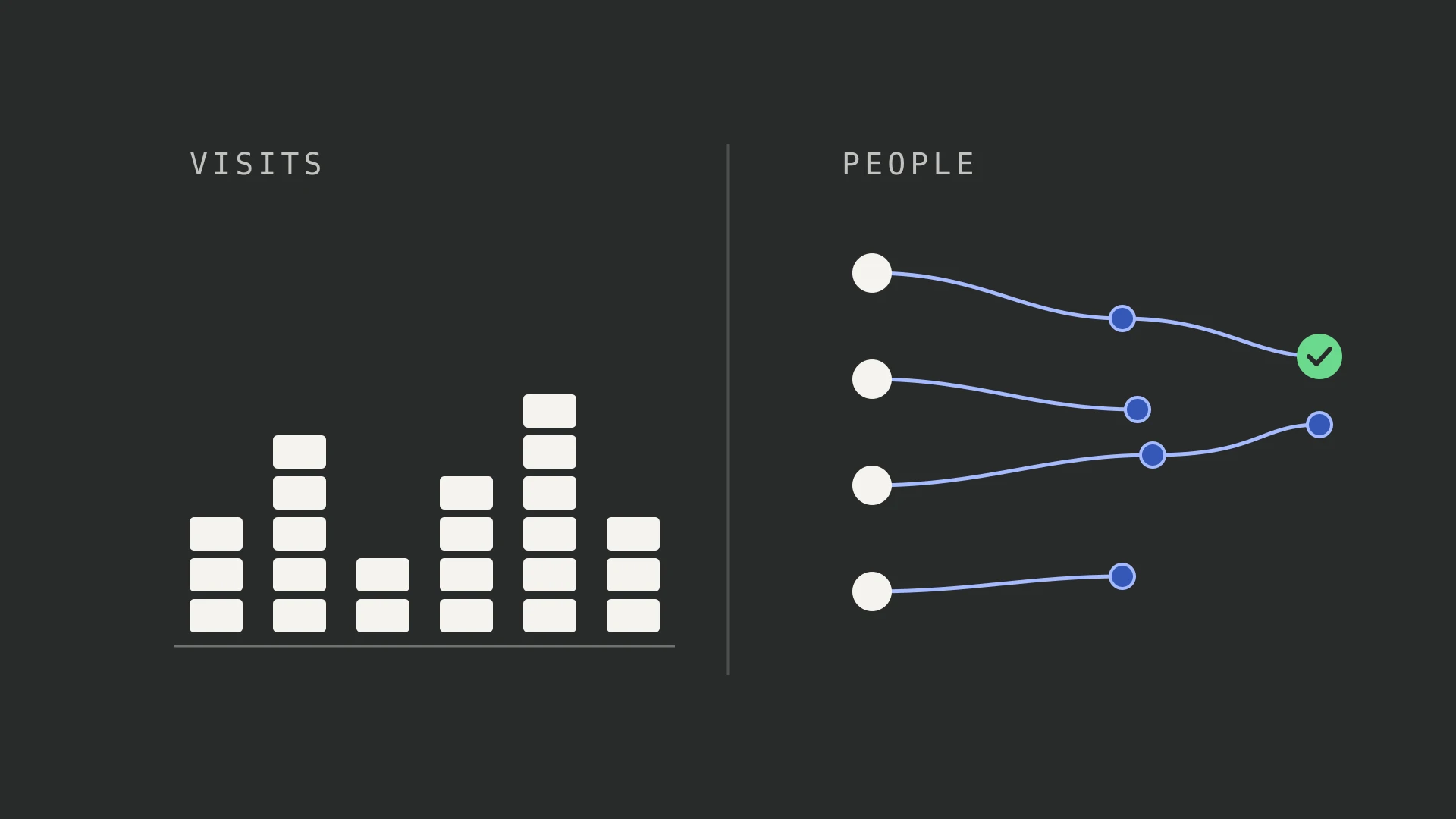
Matomo organises data around visits; PostHog organises it around the people behind the events. That shapes every report each tool gives you.
Matomo answers website questions out of the box: how many visits, from which channel or campaign, which pages, which goals and which products sold. Its reports use the same ideas as Google Analytics: visits, channels, campaigns and goals. Ecommerce reports on orders, revenue, products and abandoned carts are part of the free version. (+) Its goal conversion rate is based on visits, so a buyer who leaves and comes back the next day to pay counts as one visit that didn’t convert and one that did. (+)
PostHog records each event with the visitor’s ID. Once you identify a visitor, for example at sign-up or checkout, PostHog keeps a person profile and can follow that person across visits and devices; these identified events cost more. (+) Our person properties guide explains what a profile stores. A funnel can then follow someone from the first ad click to a purchase days later, and a breakdown can split the result by device, variant or any property you send. From the same funnel you can open the recordings of people who dropped out, put a fix behind a feature flag and run it as an experiment; our guides to session replay and running an A/B test in PostHog show both steps. The price of that flexibility is setup: someone decides which events and properties to send and keeps that plan clean.
Take a shop that wants to know why mobile buyers abandon checkout. In Matomo, the ecommerce and goal reports split by device show the drop and the value of abandoned carts, and Matomo Cloud adds funnels, heatmaps, session recordings and A/B tests to find and test a fix. In PostHog, a funnel follows the same buyers across visits to the step where they stop, recordings show what they did there, and a feature flag tests the fix on half of them. Both can answer the question: Matomo starts from the visit, PostHog from the person.
What do users say about Matomo and PostHog?
These come from forum threads, GitHub issues, reviews and blog posts from 2025 and 2026. Each is one team’s experience, not a measurement, and several include the vendor’s reply.
Matomo users
- It takes effort, and people still like it. A WordPress user who gave the plugin five stars wrote: “Do you want your data displayed with no effort invested to get them? Not Matomo.” (March 2026) (+) Across 178 ratings the plugin averages 4.6 out of 5, (+) and an October 2026 review says “the free version usually provides all the features you need to gain an overview of your website”. (+)
- Bots get counted. One site’s visits rose to 15 times the usual number, from fake visitors with 800×600 screens, zero-second visits and a 99% bounce rate. A week later the owner, who had added Matomo’s spam-prevention plugin, was still “deleting thousands of fake bot visits manually daily” (April 2026). (+) Matomo 6, released on 23 November 2026, builds that filter into the core and turns it on by default; the WordPress plugin was still on version 5.13 that week. (+ / +)
- Ad blockers hit Matomo too. A developer who moved from Google Analytics to Matomo on a Raspberry Pi found that uBlock Origin blocked the default tracker until they renamed it (May 2026). (+)
- Running it yourself is real work. On one installation tracking thousands of sites, about a million hits a day, the archiving job that builds the reports takes six hours (June 2026). (+) A developer who had self-hosted Matomo since 2014 retired it in December 2025, after running Umami beside it since 2022, writing that “Matomo has barely evolved in terms of UI”; (+) another user who runs it on their own server replied that updating takes a click and a minute. (+)
- Self-hosted bundles cost more in 2026. In August 2026 a Matomo team member confirmed on the forum that “pricing has indeed increased for our bundles for 5+ users”; single plugins can still be bought, and older prices are available to existing customers. (+)
- Plugin updates can break order tracking. After a shop updated Matomo’s WordPress plugin in May 2026, its completed WooCommerce orders stopped being recorded as ecommerce orders. Matomo posted a fix the next day and released it four days after the report. (+ / +)
- Leaving Google Analytics works, with gaps. A Swiss hosting company that sells Matomo hosting called its own move “technically manageable and worth the effort” and listed what it gave up, such as Search Console keywords. (+) A site that imported about three million page views a year of GA4 history found the monthly totals looked right, while many single pages came in several times lower (February 2026). (+)
PostHog: what we see in our work
- We measure noise before testing. Before an A/B test on a client store, we run an A/A test, where both groups see the same page, to see how far the numbers move by chance. Feature flags and experiments in the same tool make that a routine step; how we size A/B tests explains it.
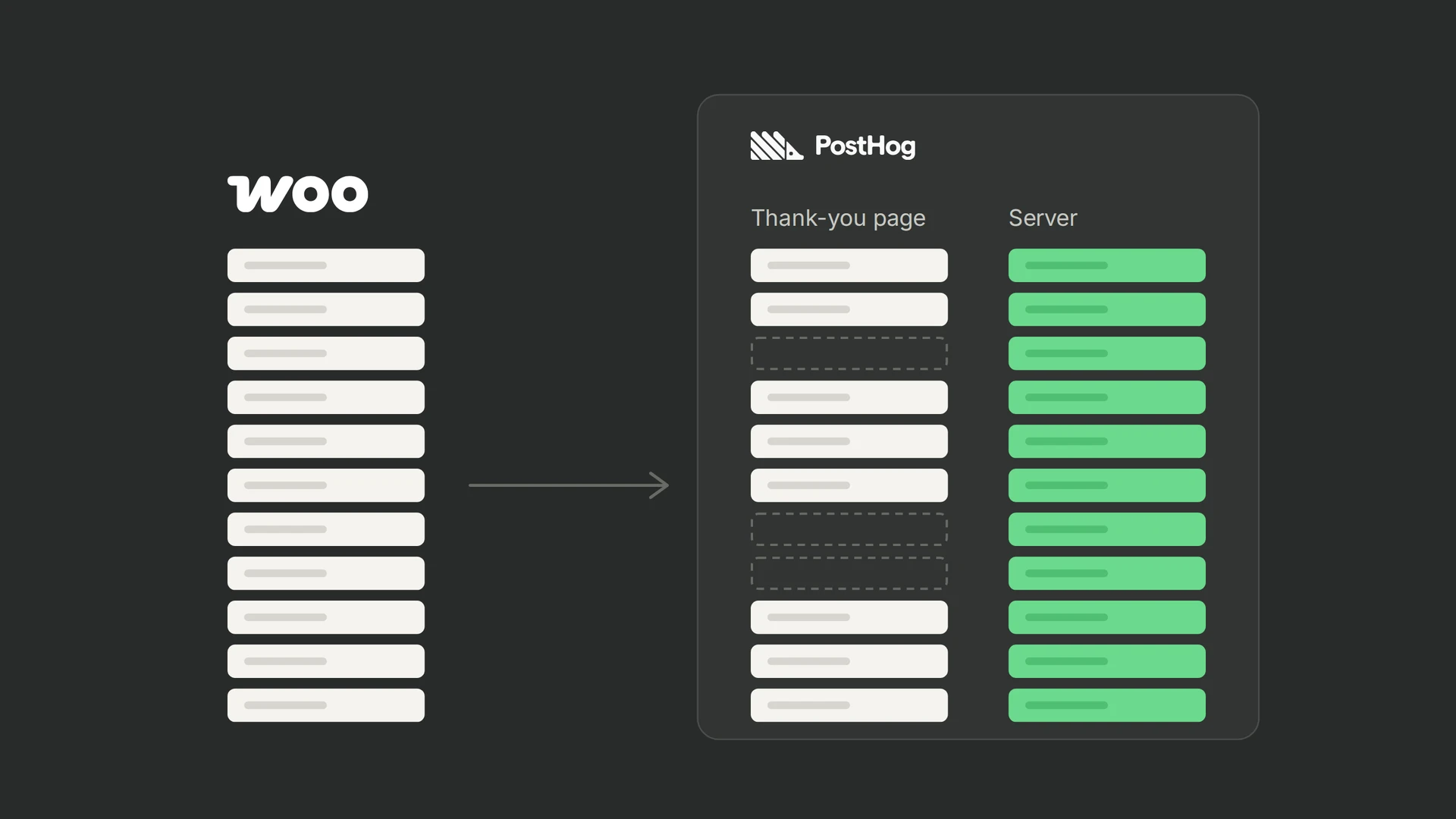
- Purchases recorded in the browser go missing. On a WooCommerce store where most buyers pay in banking apps, a plugin that recorded the purchase when the thank-you page loaded caught 73% of paid orders, and 96% on a store paid mostly by card and PayPal. Sending the order from the shop’s server closed the gap; on the stores we set up, 99Trace does that, and our WooCommerce comparison has the numbers. This is about where the purchase is recorded, so it applies to Matomo too.
- Filtering out your own team takes care. PostHog’s filter for internal users removes the people it can match. Events recorded without a person profile, such as visits before someone accepts cookies, belong to no person, so we also exclude by IP address, host and timezone. Our filtering guide shows the setup.
- Bots reach PostHog too. PostHog’s browser library drops known bots by default, (+) but disguised ones get through. On our own site we see the same fake visitors Matomo users describe, with 800×600 screens and an unknown timezone, and we drop them in code before they reach our internal feed of new visitors.
Before we trust a PostHog project, we run the checks in our PostHog audit.
PostHog: what other users report
- Self-hosting breaks. In April 2026 an engineer reported twelve separate failures installing PostHog’s self-hosted version on a clean Ubuntu 24.04 server; PostHog fixed one of them in August and added install tests. (+) In a July 2026 Hacker News thread, two users said they gave up after a day, and a third said it works fine. (+ / + / +)
- Many modules, heavy for marketers. A user who moved their team from Google Analytics to PostHog because it was simple now finds “too many modules and knobs” (July 2026). (+ / +) PostHog’s own sales handbook names the risk that a marketing team finds it too “engineering-y” and goes back to GA4, and calls its Marketing Analytics product beta. (+)
- Ad blockers cut data. One Hacker News user found PostHog blocked most of the time, which made ad conversion funnels nearly impossible to read (April 2026). (+) Another routed PostHog through a proxy, a server on their own domain that passes the data on: events came back, but Brave still blocked the session recorder (July 2026). (+) PostHog offers a managed proxy free to every Cloud customer and says a proxy typically raises captured events by 10–30%. (+)
- Separate meters surprise people. A pull request written from PostHog’s own support tickets in September 2026 describes customers who capped one product, took it for a cap on the whole account, and were billed by the others. (+)
- The free tier holds. A startup with about 5,000 monthly active users has “never paid a penny” (November 2026). (+) An agency that left Google Analytics for PostHog found interface bugs through rage clicks and recordings (October 2025, updated August 2026), (+) and a reviewer who uses it on ecommerce stores and data dashboards rated it 9 out of 10 after half a year, adding that it “needs some technical knowledge” (March 2026). (+)
Teams that compared both
- A county complaints system that runs self-hosted Matomo and PostHog Cloud plans to use PostHog for funnels that follow a person, and Matomo to keep data on its own servers (October 2026). (+)
- Ecobalyse, a French government service, chose PostHog to replace Matomo in 2025 after judging Matomo unreliable for its KPIs, and started on the free plan. (+)
The same themes run through both sets of reports:
| Theme | Matomo | PostHog |
|---|---|---|
| Praised for | Privacy, data ownership and a capable free version | Analytics, recordings, flags and tests in one place; a free tier that covers small teams |
| Learning curve | Familiar reports, but setup and custom events take effort | Built for engineers; marketers find it heavy |
| Running it yourself | Built for it, but archiving, database growth and upgrades are yours | No official support, and installs broke in 2026 |
| Data quality | Bots, ad blockers, gaps after importing GA4 | Bots, ad blockers, even for recordings behind a proxy |
| Cost surprises | Higher prices for self-hosted bundles in 2026 | A separate meter for each product |
Which is better for privacy and GDPR?
Neither tool makes a site compliant on its own: what you collect, the consent you ask for and where the data goes decide that. Matomo gives you more control over where data lives: on your own server it stays on infrastructure you run, and Matomo Cloud stores it in Frankfurt, Germany. (+) PostHog Cloud runs in the US or in the EU, also in Frankfurt, and PostHog recommends the EU region for GDPR. (+) You choose the region when you create the account; our PostHog setup guide covers that choice.
Whether you can drop the cookie banner depends on local law, not on the tool. Matomo’s own guidance is that France, Spain, Italy and the Netherlands exempt some audience measurement when strict conditions are met, while for Germany it recommends treating JavaScript tracking as needing consent. (+) Since version 5.9 (April 2026), one setting applies the French CNIL exemption’s conditions: audience measurement only, masked IP addresses, data kept for at most 25 months, and the visits log, visitor profiles, A/B tests, heatmaps and session recordings switched off. Matomo calls its compliance with the CNIL criteria a self-assessment. (+ / +) Without cookies, Matomo counts every visit as a new visitor, so its unique, new and returning visitor numbers become inaccurate. (+)
PostHog recommends loading its library switched off and switching it on for each visitor after consent, or using its cookieless mode for everyone or only for visitors who decline. (+) Cookieless mode replaces the cookie with a hash that PostHog’s servers compute and change daily. No cookie is set, but a returning visitor counts as new each day, recordings and surveys stay off until the visitor consents, and the mode has no location data or bot detection. (+)
In Matomo’s WordPress plugin, orders from cookieless visitors aren’t linked to the visit that led to them unless you turn on its server-side visitor ID, which uses WooCommerce’s session cookie. Matomo’s developer said sites subject to GDPR or ePrivacy rules couldn’t legally use it. (+ / +)
AI features also change how your data is used. In May 2026 PostHog announced that it will train its own AI models on anonymised data in customers’ projects, with training starting no earlier than 29 June. Organisations on US Cloud are opted in by default unless an agreement such as a BAA rules it out, those on EU Cloud are opted out, and an admin can opt out in the organisation settings. PostHog says it won’t send the data to third-party model providers. (+)
Matomo has announced Ask Matomo, an AI chat, for November 2026. Once a super user turns it on, each question sends aggregated report data to an AI provider: Amazon Bedrock on Matomo Cloud, where some models may process requests outside the EU, or a provider you choose on your own server, which can be a local model. Matomo warns that aggregated report data is not automatically free of personal data. (+)
Can you self-host Matomo and PostHog?
Matomo, yes: it was built for it. PostHog has a self-hosted version, but does not support it.
Matomo On-Premise is free, with no limit on hits. Matomo 6, released on 23 November 2026, needs PHP 8.1 and MySQL 8.0 or MariaDB 10.6. Matomo suggests a server with 2 CPUs and 2 GB of memory for up to 100,000 page views a month, and two or more servers above a million actions a month. (+ / +) Above a few hundred visits a day, an hourly scheduled job should build the reports, instead of building them when someone opens them. (+)
Self-hosting means you look after the server, the database as it grows, and the upgrades; the user reports above show what that can involve. In November 2026, funnels, heatmaps and session recordings come in paid bundles from €230 a month on yearly billing (Team: up to 4 users and 5 million hits a month), and A/B testing comes with the Enterprise bundle. (+) Bought one by one for up to 4 users, Heatmap & Session Recording and A/B Testing cost €219 a year each and Funnels €199 a year. (+ / + / +)
The WordPress plugin is the lightest route: it runs Matomo inside WordPress, keeps the data there and uses WordPress’s own scheduler, though Matomo recommends On-Premise or Cloud for high-traffic sites. (+)
PostHog’s self-hosted “hobby” version runs with Docker Compose on roughly a 4-CPU, 16 GB machine. Its documentation says “self-hosted deployments are officially unsupported”: PostHog gives no customer support for them, paid features are Cloud-only, and anyone expecting more than 300,000 events, 1,000 recordings or 300,000 flag requests is told to self-host only if running infrastructure is a core skill. (+) One engineer ran the full stack on Kubernetes; it took three weeks and 238 commits with AI coding agents (September 2026). The engineer self-hosted because PostHog is a US company under US law, which ruled its cloud out for that project. (+)
If your data must stay on servers you run, Matomo is the practical choice. If it only has to be stored in the EU, both clouds store it in Frankfurt.
How do Matomo and PostHog track WooCommerce orders?
Both can record an order in the buyer’s browser when the thank-you page loads, or send it from the shop’s server. Only the server route keeps the orders of buyers who block tracking, or who pay in a banking app and come back in another browser or not at all. Our measurements above show how many orders that can be.
Matomo
- The Matomo Analytics plugin for WordPress is free, runs Matomo inside WordPress and supports WooCommerce out of the box. (+) It records product views, cart changes and orders. In its current release (5.13.1), the order is recorded in the buyer’s browser when the thank-you page loads. (+) It sends the order from the shop’s server only in some cases: when WooCommerce marks the order paid during a background request (AJAX or REST) instead of a page load, when the plugin tracks through Matomo Tag Manager, or when the site owner sets
MATOMO_TRACK_ECOMMERCE_SERVER_SIDEinwp-config.php. Those server sends wait three minutes by default. (+ / +) If your payment provider confirms payments by calling your shop directly, place a test order and check that it reaches Matomo. Cancelled, failed and refunded orders are left out by default. (+) - WooCommerce Analytics, Matomo’s own premium plugin, connects a WooCommerce shop to Matomo Cloud or your own Matomo. It sends orders and cart updates from the shop’s server, so it “tracks orders and cart updates even if a user is using an ad-blocker”; page views still need a tracking plugin. In November 2026 it costs €139 a year after a 30-day trial on your own server, and it is included in Matomo Cloud. (+ / +)
PostHog
- PostHog has no official WooCommerce plugin. It documents adding its snippet with a code plugin, and a data warehouse source that copies WooCommerce orders, products and customers as tables for SQL reports. (+ / +)
- 99Trace is a free, open-source WordPress plugin that sends WooCommerce data to PostHog from the shop’s server. It sends each order when WooCommerce marks it paid, on the visitor who placed it, and its site says each order arrives exactly once. Refunds, cancellations, failed payments, and cart and checkout events go the same way, so revenue in PostHog follows WooCommerce. It can also run PostHog in the browser for page views, heatmaps and session replay. In November 2026 its version 1.1.1 needs WordPress 6.5, WooCommerce 8.7 and PHP 8.0, and its WordPress.org listing is in review. (+) Its site explains how it works, how to set it up and privacy and consent, and the documentation lists every setting.
- Other plugins not made by PostHog: AG Data for PostHog also sends each order from the server when it is paid, and Tagbridge says it does the same; Tehster’s PostHog Integration, a paid plugin, records the order on the thank-you page. Our comparison of every method covers what each one sends.
How much do Matomo and PostHog cost in November 2026?
In November 2026, a small site pays nothing for PostHog Cloud below its free allowance, and PostHog says 97% of companies use it for free. (+) Matomo Cloud starts at €22 a month, and Matomo on your own server is free software with paid premium features. At 2 million events a month, PostHog’s bill is lower than Matomo Cloud’s even if every event is identified ($248 against €334), but the two tools count different things.
These are Matomo Cloud’s Business plan prices in November 2026, in euros, excluding tax and billed monthly. A year costs ten months’ price. (+)
| Hits a month | Price a month | Session recordings included | Heatmap page views included |
|---|---|---|---|
| 50,000 | €22 | 150 | 1,500 |
| 100,000 | €38 | 300 | 3,000 |
| 300,000 | €75 | 500 | 5,000 |
| 1 million | €172 | 1,000 | 10,000 |
| 2 million | €334 | 1,500 | 15,000 |
| 5 million | €822 | 5,000 | 50,000 |
A hit is a page view, an event, a download, an outlink, a site search or a content-tracking request. Extra hits cost €2.20 per 5,000 on the smallest plan. (+)
PostHog Cloud gives every organisation 1 million events, 5,000 session recordings, 1 million feature flag requests, 100,000 exceptions and 1,500 survey responses free each month. Above that, in November 2026, an anonymous event costs $0.00005. An identified event, one linked to a person profile, costs $0.000198 more. A recording costs $0.005 and a flag request $0.0001, with lower prices at higher volumes. You can set a billing limit on most products; at the limit, PostHog drops further data instead of charging. (+)
Take a site that records 2 million page views and events a month in November 2026. Matomo Cloud costs €334 a month, with 1,500 recordings. PostHog Cloud bills the second million events: $50 if they are anonymous, $248 if they are all identified, plus $0.005 for each recording beyond 5,000. At 300,000 a month, Matomo Cloud costs €75 and PostHog nothing. This assumes one Matomo hit for each PostHog event.
That assumption rarely holds. By default, PostHog’s browser library records page views, page leaves and clicks on links, buttons and forms, (+) so one page view often brings several PostHog events. Our cost guide shows how to cut the ones you don’t use.
On your own server, Matomo has no licence fee and no hit limit. You pay for the server, your time and any premium features, such as WooCommerce Analytics at €139 a year or a bundle from €230 a month (November 2026).
What changed in Matomo and PostHog in 2026?
Both tools added AI features this year. Matomo also shipped its first major version since 2023 and raised the price of its self-hosted bundles.
Matomo
- March 2026 (5.8): reports that count AI chatbot requests apart from human visits. (+) An “AI Assistants” channel, for visitors referred by ChatGPT, Copilot, Gemini, Claude or Perplexity, came earlier, in version 5.5 in October 2025. (+)
- April 2026 (5.9): CNIL compliance in one setting, described under privacy above. (+)
- May 2026: a refreshed interface with dark mode in version 5.10, (+) and the Matomo MCP server, a connector that lets AI assistants such as Claude, ChatGPT or Codex query your Matomo data. (+)
- August 2026: higher prices for self-hosted bundles of five or more users. (+)
- September 2026 (5.14): real-time visitor counts that work with the visits log switched off. (+)
- November 2026: Matomo 6.0, the first major release since December 2023, with the bot filter built in and the newer PHP and MySQL versions it needs. (+) Ask Matomo, the AI chat, is announced for the same month. (+)
PostHog
- May 2026: PostHog Code, a desktop app that runs coding agents on your product data, entered beta; it is now called PostHog Desktop. (+) PostHog also announced that it will train its own AI models on anonymised customer data, with US Cloud opted in by default (see privacy above).
- July 2026: web analytics got an “AI” channel for visitors who arrive from ChatGPT, Claude, Gemini, Perplexity or Copilot, and older sessions were reclassified too. (+ / +)
- End of July 2026: Replay Vision, AI that watches session recordings and turns what it sees into data you can query, billed in credits with 2,500 free a month. (+ / +)
- September 2026: the WooCommerce data warehouse source became generally available. (+)
PostHog AI, the assistant inside the app, became generally available in November 2025 and is billed in AI credits, with $5 of credits free each month. (+ / +)
Which should you choose?
Pick by the job, then check the price at your volume. Prices here are from November 2026.
| Situation | Better fit | Why, and the limit |
|---|---|---|
| A blog or content site that wants Google Analytics-style reports | Matomo | Ready-made traffic and campaign reports. Cloud costs from €22 a month and the self-hosted software is free, but heatmaps and recordings cost extra on your own server. PostHog’s web analytics is free at this size, and its Marketing Analytics product is still in beta. |
| Data must stay on servers you run | Matomo On-Premise | Built for self-hosting; you carry the upkeep and pay for premium features. |
| A SaaS product or web app | PostHog | Follows each person across visits, with retention, flags and experiments; it needs a developer and an event plan. |
| A WooCommerce store | Either | Matomo’s WordPress plugin gives ecommerce reports out of the box, and Matomo Cloud adds funnels, recordings and A/B tests. PostHog follows each buyer across visits, next to its recordings and tests. Either way, send orders from the shop’s server: with Matomo’s WooCommerce Analytics, or with a plugin such as 99Trace for PostHog. |
| Regular A/B testing | PostHog | Experiments run on feature flags, with Bayesian or frequentist statistics, next to the funnels and recordings you read them with. Variants are usually built in code, and flag requests above 1 million a month are billed. Matomo’s A/B tests come with Matomo Cloud, or cost €219 a year as a plugin on your own server for up to 4 users. |
| A marketing team reporting on campaigns | Matomo | Reports built around channels and campaigns. On your own server, multi-channel attribution needs the Business bundle, from €1,209 a month on yearly billing. PostHog’s own handbook says marketers may find PostHog engineering-heavy. |
Can you use Matomo and PostHog together?
Yes. One split that works is Matomo for traffic and campaign reports, especially where they must stay on your own servers, and PostHog for the product or the funnels you test, as the county complaints system above plans.
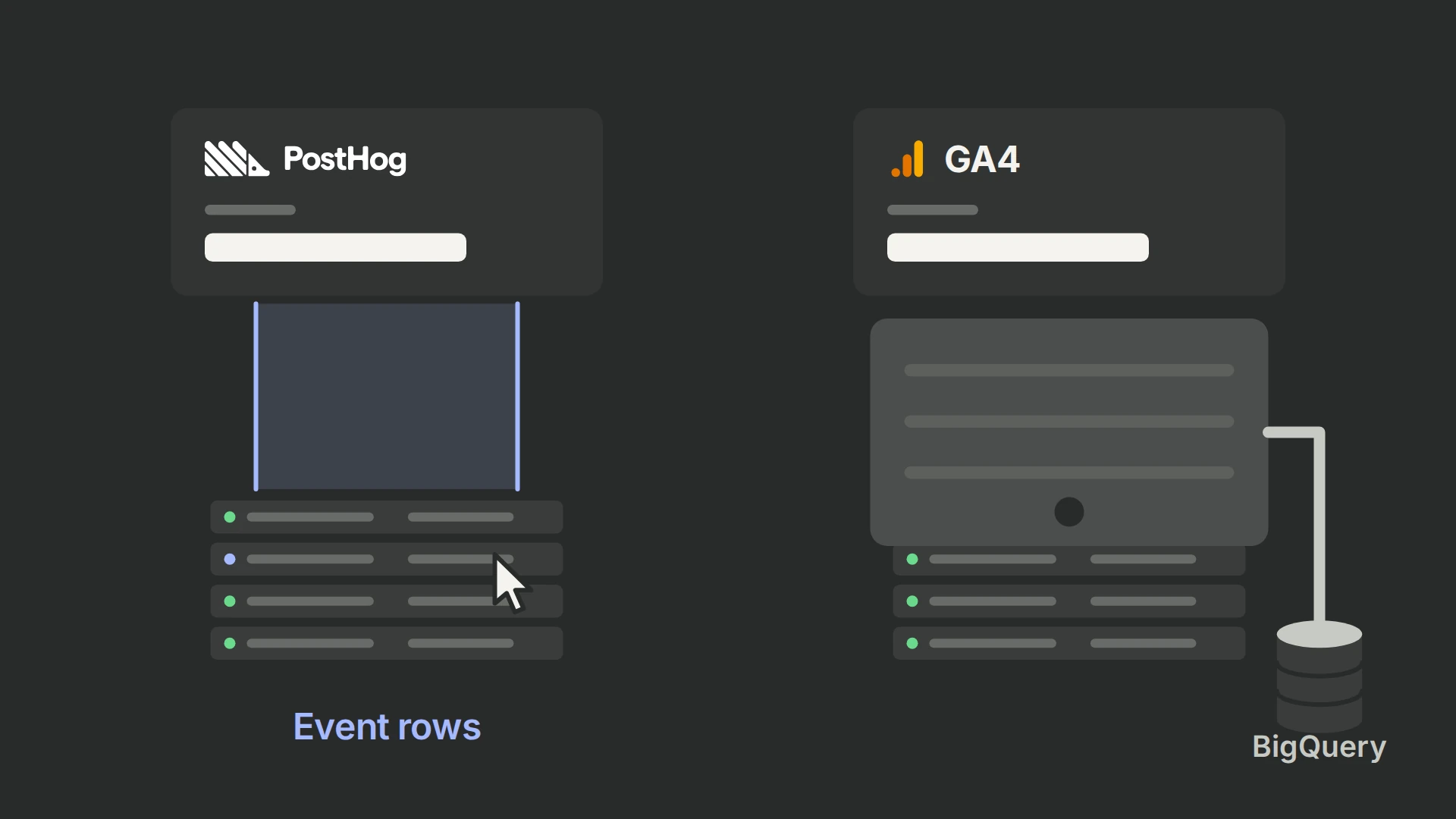
Running both costs you two scripts on every page, a consent setup that covers both, and two sets of numbers that will not match. Matomo counts visits and PostHog follows people. Without cookies, Matomo counts every visit as a new visitor, while PostHog’s cookieless mode counts a returning visitor as new each day. Ad blockers and bot filters treat each script differently. Even Matomo and GA4 disagree: a German site that compared cookieless Matomo with consent-based GA4 in March 2025 counted 7.2% fewer visitors in Matomo, although 46% of its visitors refuse statistics cookies, and the forum thread found no single cause. (+) Decide which tool answers which question before you compare their numbers.
Frequently asked questions
Is Matomo free?
Matomo On-Premise is free to download and use on your own server, with no limit on hits; premium features such as heatmaps and A/B testing cost extra. Matomo Cloud has a free trial and then starts at €22 a month for 50,000 hits (November 2026). (+)
Does PostHog have heatmaps?
Yes: heatmaps of clicks, rage clicks and mouse movement, plus scroll maps and click maps. On the free plan PostHog collects heatmaps for up to three pages you choose (November 2026); viewing them in the toolbar needs the pay-as-you-go plan. (+)
Is there an official PostHog plugin for WordPress or WooCommerce?
No. Matomo has an official WordPress plugin; PostHog’s WordPress guide adds its snippet with a header-and-footer plugin such as WPCode, through Google Tag Manager, or in the theme’s files. (+) How we installed PostHog on WordPress walks through one setup, and our WordPress A/B testing guide adds experiments. For WooCommerce orders, 99Trace is a free, open-source plugin that sends them to PostHog from the shop’s server; its setup guide takes seven steps from the plugin file to the first order in PostHog. (+)
Can Matomo import Google Analytics data?
Yes. The free Google Analytics Importer brings reports from a Google Analytics account into Matomo; it is installed by default on Matomo Cloud and takes a few clicks on your own server. (+ / +) Compare a few pages after the import, not only the totals. For a move to PostHog instead, our switching guide shows how to leave Google Analytics without losing data.